Types of Slang: Slang is informal language that a group uses to sound casual, creative, or “in the know.” The main types of slang are acronyms (NGL, FR), clipped words (sus, rizz), old words with new meanings (cooked, lit), compound slang (glow up, crash out), rhyming slang, back slang, emoji and symbol slang, plus slang grouped by who uses it, like Gen Z, gaming, internet, regional, and dating slang.
Most “types of slang” articles just list 20 trendy words. This guide goes further. You’ll learn how slang is actually formed, how it differs from jargon and dialect, how a slang word is born and dies, and you’ll get a short quiz (with answers) to test yourself. Every section links to our detailed meaning guides, so this page works as your complete slang hub.
Types of Slang at a Glance
| Type of Slang | How It Works | Examples |
|---|---|---|
| Acronyms & initialisms | First letters of a phrase | NGL, FR, SMH, IRL |
| Clipped slang | A long word gets shortened | Sus, rizz, delulu, fam |
| Semantic shift | An old word gets a new meaning | Cooked, lit, aura, rack |
| Compound & blend slang | Two words join together | Glow up, crash out, aura farming |
| Creative spelling | Words spelled to sound cute or funny | Bussin, smol, thicc |
| Rhyming slang | A rhyming phrase replaces a word | “Apples and pears” = stairs |
| Back slang | A word is said backwards | “Yob” = boy |
| Emoji, number & symbol slang | Symbols carry the meaning | 💀, “…”, 143, XD |
| Group slang | Belongs to a community | Gen Z, gaming, Discord, regional |
What Is Slang? (Simple Definition)
Slang is very informal vocabulary used in everyday talk and texting, but usually avoided in formal writing. It helps people show they belong to a group, sound playful, and say things faster.
The word “slang” was first recorded in 1756, when it described the language of “low” or disreputable people. Around 1800 it was used for the secret talk of London’s criminal underworld. Today, slang is everywhere, from TikTok comments to group chats.
Linguists Bethany Dumas and Jonathan Lighter suggested a word counts as true slang if it does at least two of these things:
- It lowers the seriousness of formal speech or writing.
- It shows you are familiar with a group or topic.
- It would feel out of place when talking to someone of higher status, like a boss or teacher.
- It replaces a normal word that already exists.
Slang vs. Jargon vs. Colloquialism vs. Dialect
These terms get mixed up a lot. Here’s the simple difference:
| Term | What It Means | Example |
|---|---|---|
| Slang | Informal, trendy words used by a social group | “That fit is fire.” |
| Jargon | Technical words used in a job or field | “SEO,” “bandwidth,” “ROI” |
| Colloquialism | Casual but widely accepted everyday words | “Gonna,” “kinda,” “y’all” |
| Dialect | A full language variety of a region or group, with its own grammar and accent | Southern American English, Scottish English |
| Argot / Cant | Secret language used to hide meaning from outsiders | Thieves’ cant, Polari |
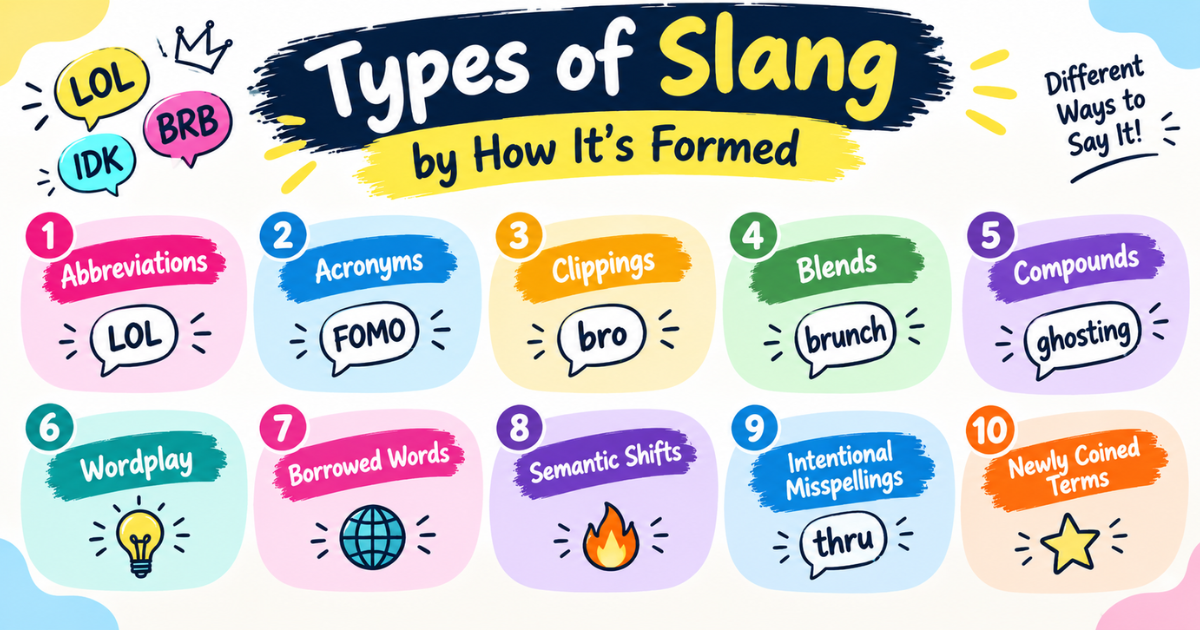
Types of Slang by How It’s Formed
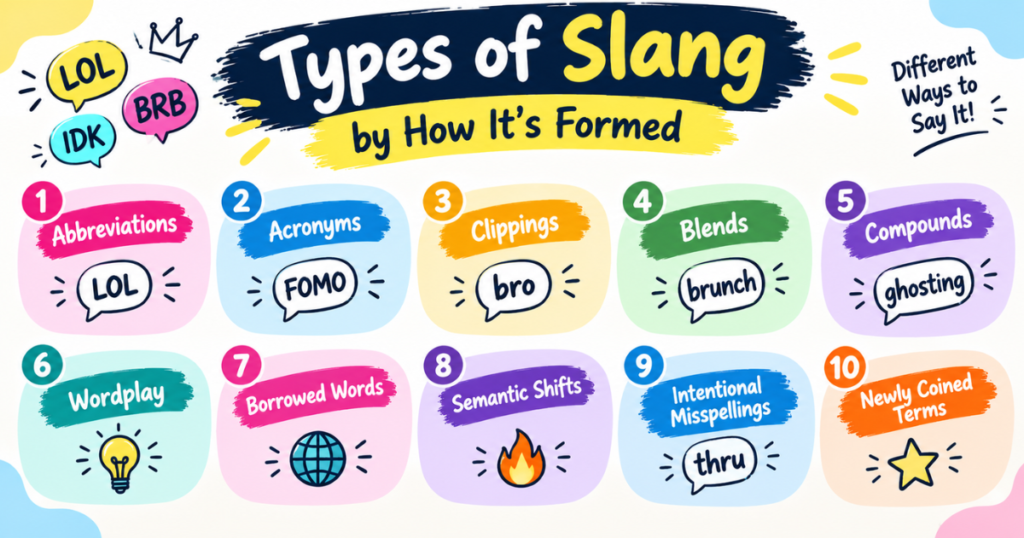
This is the part most guides skip. Almost every slang word you see online was created using one of these methods.
1. Acronyms and Initialisms
The most common type of texting slang. A phrase is cut down to its first letters, which makes typing faster.
- NGL – not gonna lie
- FR – for real
- SMH – shaking my head
- IRL – in real life
- ISTG – I swear to God
- IJBOL – I just burst out laughing
- LMK – let me know
See 100+ more in our texting abbreviations guide.
2. Clipped Slang (Shortened Words)
Linguists call this clipping: part of a longer word is dropped, and the short form takes on its own vibe.
- Sus – from “suspicious”
- Rizz – from “charisma”
- Delulu – from “delusional”
- Fam – from “family”
- Vibe – from “vibration”
3. Semantic Shift (Old Words, New Meanings)
An everyday word is given a fresh slang meaning. This is how many viral TikTok terms are born.
- Cooked – in big trouble or exhausted, not food
- Aura – your cool factor or social energy
- Rack – money, not a shelf
- Lit – meant “drunk” in older slang; later came to mean exciting
- Ghost – to stop replying to someone suddenly
4. Compound and Blend Slang
Two words join together to make a new idea, or two words are blended into one.
- Glow up – a major positive transformation
- Crash out – to lose control emotionally
- Aura farming – acting cool on purpose to gain “aura points”
- Situationship – “situation” + “relationship”
5. Creative Spelling Slang
Words are spelled the way they sound, or made “cuter” or more dramatic.
- Bussin – really good (often about food)
- Smol – small and cute
- Periodt – an extra-strong “period,” meaning end of discussion (see period meaning in text)
6. Rhyming Slang
Famous in London as Cockney rhyming slang. A word is replaced by a phrase that rhymes with it, and then the rhyming part is often dropped.
- Apples and pears – stairs
- Dog and bone – phone
- Use your loaf – “loaf of bread” = head, so “use your head”
7. Back Slang
Words are spoken backwards. Victorian street sellers in London used it so customers wouldn’t understand them.
- Yob – “boy” backwards, now means a rude young man
- Verlan – the French version, where syllables are flipped, like meuf from femme (woman)
8. Emoji, Number, and Symbol Slang
In digital chats, symbols carry meaning on their own.
- 💀 Skull emoji – “I’m dead,” meaning something is extremely funny
- “…” three dots – pause, hesitation, or awkwardness
- XD – laughing face made from letters
- 143 – “I love you” (number of letters in each word)
- 12 – the police, most likely from the 1968 TV show Adam-12 (see why is 12 slang for police)
9. Borrowed Slang (Loanwords)
Slang often moves from one community or language to another. Musicians gave us “gig,” gamers gave us “noob,” and many words from Spanish, Jamaican Patois, and other languages have entered English slang through music and social media.
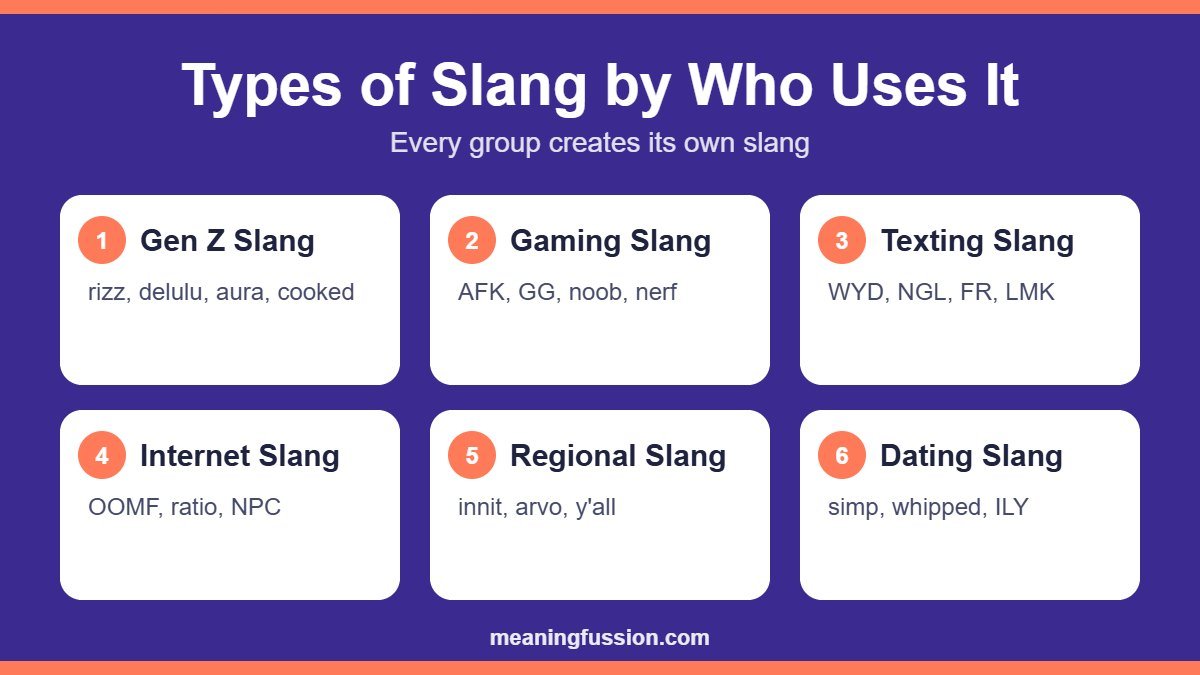
Types of Slang by Who Uses It
Gen Z Slang
The fastest-changing type of slang today, mostly spread through TikTok and group chats. Examples: rizz, delulu, aura, cooked, and SYBAU. Explore our full Gen Z Slang Dictionary and learn what Gen Z means in text.
Millennial and Older Slang
Words like “on fleek,” “YOLO,” “groovy,” and “rad” show how every generation creates its own slang. “Groovy,” for example, is a relic of 1960s and 70s hippie culture.
Internet and Social Media Slang
Created on platforms like X (Twitter), TikTok, Snapchat, and Discord. Examples: OOMF, ratio, main character, and NPC. Check our Discord slang guide for server-specific terms.
Texting Slang
Short, fast, and mostly acronyms: WYD, HYD, WSG, ICL, HBU, IKR, IDEK, and CYA.
Gaming Slang
Born in online games and voice chats, then spread everywhere: AFK (away from keyboard), GG (good game), noob, and nerf.
Regional Slang
Slang tied to a place. British slang (“innit,” “peng”), Australian slang (“arvo” for afternoon), and American regional slang like hillbilly slang all fall here.
Community and Cultural Slang
Many popular words started in specific communities. A large share of today’s internet slang, including “slay,” “tea,” and “periodt,” comes from African American English (AAVE) and LGBTQ+ ballroom culture. Knowing where a word comes from helps you use it respectfully.
Dating and Relationship Slang
Words for crushes, partners, and feelings: slang for boyfriend, whipped, simp, and ILY.
Secret Slang (Cant and Argot)
Some slang exists to hide meaning. Thieves’ cant was used by English criminals around 1600, and Polari was used by gay men in Britain in the 20th century when being openly gay was dangerous.
Types of Slang by Purpose
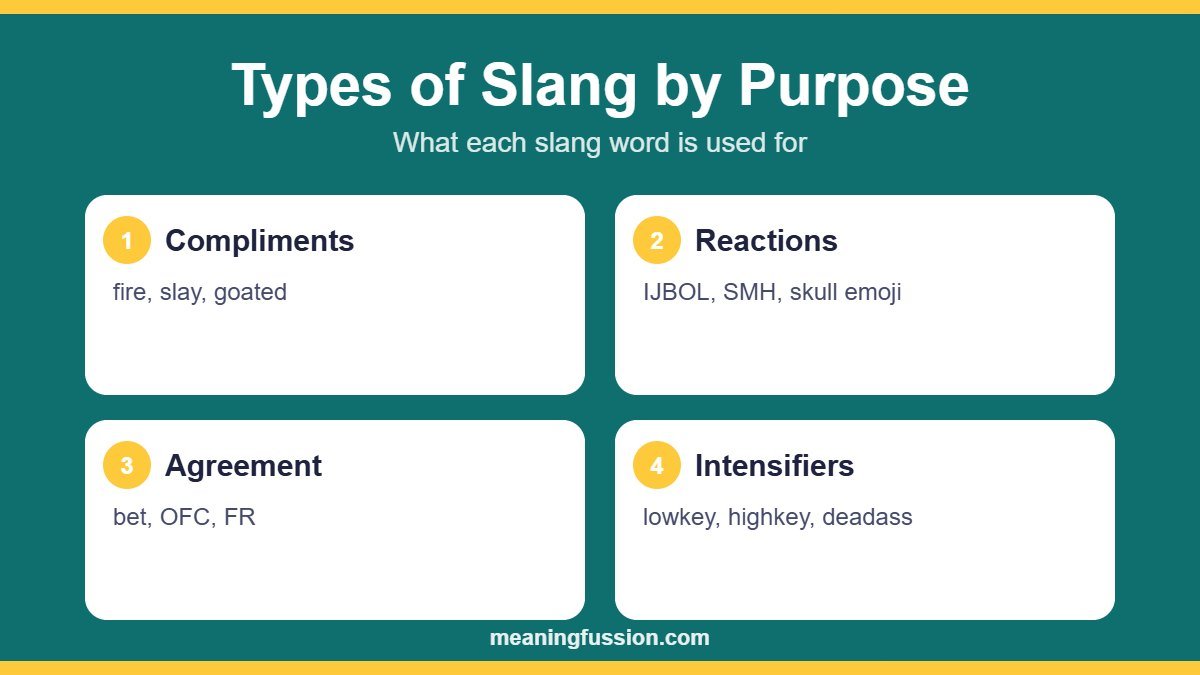
- Compliment slang: fire, slay, goated. See slang words for cool and slang for awesome.
- Reaction slang: IJBOL, SMH, 💀, HMG.
- Agreement slang: bet, OFC, FR.
- Intensifiers: lowkey, highkey, deadass, ATP.
- Insult or teasing slang: mid, cringe, NPC, cooked.
The Life Cycle of a Slang Word
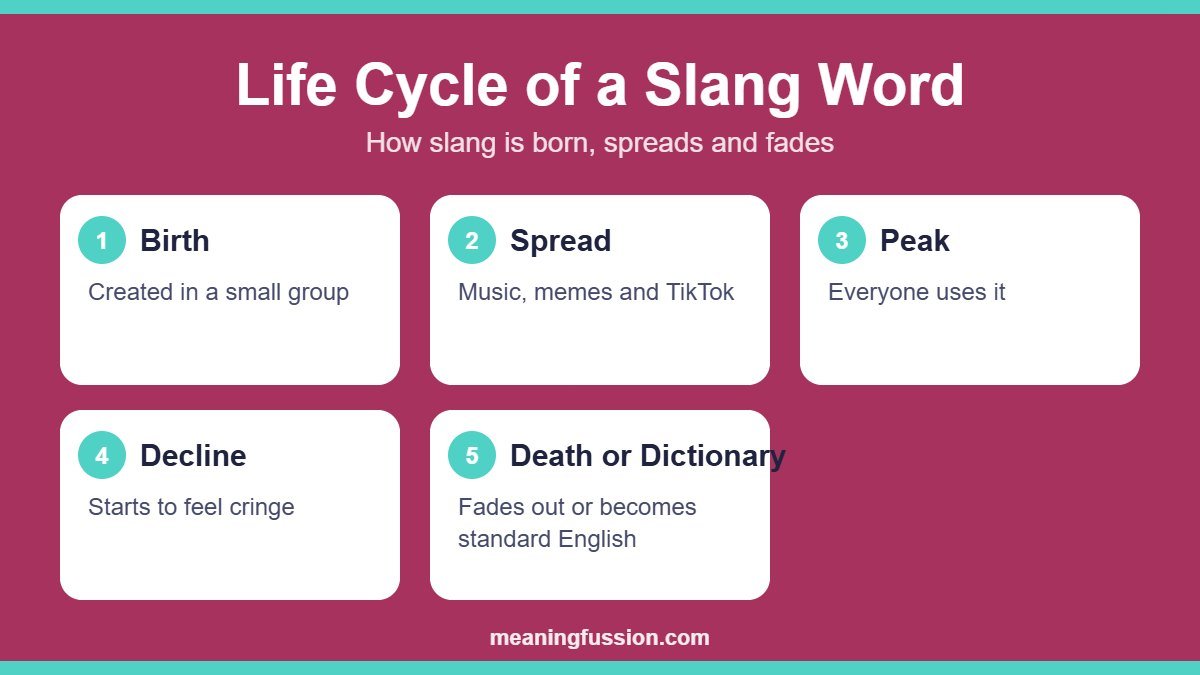
- Birth: A word is created inside a small group (a neighborhood, a fandom, a gaming server).
- Spread: Music, memes, and TikTok carry it to a bigger audience.
- Peak: Everyone uses it, including brands and parents.
- Decline: Once it feels “cringe” or overused, the original group drops it.
- Death or dictionary: It either fades away (like “on fleek”) or becomes standard English (like “mob,” which was once slang).
Lexicographer Eric Partridge, one of the first people to study slang seriously, estimated that a slang word is used in speech for about ten years before it shows up in writing. Thanks to the internet, that cycle now happens in months.
How to Use Slang Without Sounding Cringe
- Know your audience. Slang fits friends and social media, not job interviews or client emails.
- Learn the real meaning first. Many words have double meanings. Look it up before you use it.
- Don’t overdo it. One or two slang words feel natural. Ten in one sentence feels forced.
- Respect the origin. Avoid slang that mocks a group, and learn which community a word came from.
- Stay current. Slang ages fast. Check our latest guides before using a trend.
Quick Quiz: Test Your Slang Knowledge
- “Sus” is an example of which type of slang?
- “Apples and pears” means stairs. What type of slang is this?
- “NGL” is formed using which method?
- “Cooked” originally meant prepared food. What process gave it a slang meaning?
- “Yob” comes from which word spelled backwards?
Answers: 1. Clipped slang (from “suspicious”) · 2. Rhyming slang · 3. Acronym · 4. Semantic shift · 5. Boy
Examples of Different Types of Slang in Sentences
Seeing each type in a real sentence makes it easier to spot. Here is how the main types of slang look in everyday chats:
| Type of Slang | Example Sentence | Meaning |
|---|---|---|
| Acronym | “NGL, that movie was mid.” | Not gonna lie, it was average. |
| Clipping | “He’s acting kinda sus.” | He seems suspicious. |
| Semantic shift | “I have three exams tomorrow, I’m cooked.” | I’m in big trouble. |
| Compound | “She had a total glow up this year.” | She improved a lot. |
| Creative spelling | “This biryani is bussin.” | This food is really good. |
| Rhyming slang | “Get on the dog and bone.” | Get on the phone. |
| Symbol slang | “💀💀💀” | That’s extremely funny. |
Types of Slang Around the World
English is not the only language with creative slang. Different countries have their own types of slang, and many of them use the same tricks you learned above.
- British slang: “Innit” (isn’t it), “peng” (attractive), and “gutted” (very disappointed).
- Australian slang: Australians love clipping. “Arvo” means afternoon, “brekkie” means breakfast, and “servo” means petrol station.
- French slang (Verlan): Syllables are flipped, so “louche” (shady) becomes “chelou.”
- Spanish slang: Words like “neta” (truth) in Mexico and “guay” (cool) in Spain.
- Roman Urdu / Hinglish chat slang: South Asian texters mix English and local words, like “scene on hai” (plans are set) or “kya vibe hai” (what a mood).
Why Do People Use Different Types of Slang?
People don’t use slang just to sound trendy. Each of the types of slang serves a real purpose in communication:
- To show they belong. Using the same slang as your friends signals that you are part of the group.
- To save time. Acronyms like LMK and WYD make texting faster.
- To add emotion. Slang like “I’m dead 💀” shows feelings that plain words can’t.
- To be funny and creative. Playing with words is fun, and new slang often starts as a joke.
- To keep secrets. Older types of slang like thieves’ cant and back slang were made so outsiders couldn’t understand.
How to Learn New Types of Slang Fast
- Watch where it’s used. TikTok comments, Discord servers, and X (Twitter) replies are where most new slang appears first.
- Identify the type. Ask yourself: is it an acronym, a clipped word, or an old word with a new meaning? Knowing the types of slang helps you guess the meaning.
- Check a trusted guide. Look up unfamiliar words in our Gen Z Slang Dictionary before using them.
- Practice in safe spaces. Try new slang with close friends first, not in work emails.
Where Each Type of Slang Fits (Formal vs. Informal)
Not all types of slang are equally casual. Some are fine in a friendly work chat, while others should stay in your group chat. Use this quick guide before you hit send:
| Type of Slang | Group Chat | Work Chat | Formal Email |
|---|---|---|---|
| Texting acronyms (LOL, BRB) | Yes | Sometimes | No |
| Gen Z slang (rizz, cooked) | Yes | Rarely | No |
| Emoji and symbol slang (💀, …) | Yes | Careful | No |
| Colloquial words (gonna, kinda) | Yes | Yes | Avoid |
| Regional slang (y’all, innit) | Yes | Depends on team | No |
Types of Slang in Movies, Music, and Pop Culture
Pop culture is the fastest engine for spreading new types of slang. Rap and hip-hop lyrics made words like “drip” and “lit” global. Reality TV gave us “spill the tea,” and video games pushed “GG” and “noob” into everyday speech. Even the 1941 movie Ball of Fire was about a professor studying slang, which shows people have been curious about the different types of slang for a long time.
Today, a single viral TikTok sound can create a new word in a week. That’s why understanding the types of slang matters more than memorizing a fixed list: words change fast, but the patterns behind them stay the same.
FAQs About Types of Slang
How many types of slang are there?
There is no fixed number. Slang is usually grouped in three ways: by how it’s formed (acronyms, clipping, rhyming, back slang, etc.), by who uses it (Gen Z, gaming, regional), and by purpose (compliments, reactions, insults).
What is the most common type of slang today?
Internet and texting slang, especially acronyms like NGL, FR, and LMK, plus Gen Z words spread through TikTok.
What is the difference between slang and jargon?
Slang is informal and social, used to sound casual or belong to a group. Jargon is technical language used in a specific job or field.
Is slang bad English?
No. Linguists see slang as a normal, creative part of language. It’s just informal, so it doesn’t suit formal writing.
Why does slang change so fast?
Once a slang word becomes mainstream, it stops feeling special, so younger groups create new words. Social media speeds this up.
Can slang become an official word?
Yes. Many words, like “mob” and “selfie,” started as slang and are now in standard dictionaries.
What are the 5 main types of slang?
The five most common types of slang are acronyms (NGL, FR), clipped words (sus, rizz), semantic shift (cooked, lit), compound slang (glow up, crash out), and emoji or symbol slang (💀, “…”).
What type of slang is LOL?
LOL is an acronym, one of the most common types of slang in texting. It stands for “laughing out loud.”
Are memes a type of slang?
Memes are not slang themselves, but they are one of the biggest ways new types of slang spread online.
Explore Our Slang Library
Use these guides to go deeper into each type of slang:
- Texting acronyms: TS, OTG, WTW, NTH, WYO, OBO, JP, BD, TMW, LOK
- Gen Z and TikTok slang: Aura, Crash Out, Delulu, Rizz, 12 Powerful Slang Words
- Feelings and reactions: IKYFL, LML, OSNS, HGS, WUT
- Symbols and punctuation: Three Dots (…), Period, Skull Emoji 💀
- Compliments: Slang for Cool, Slang for Awesome
Final Thoughts
Understanding the types of slang makes every new word easier to decode. Once you know that “sus” is clipping, “cooked” is semantic shift, and “NGL” is an acronym, you can figure out most new slang on your own. Bookmark this guide, and check back as we add new meanings every week.

Rose Lily
I’m Rose Lily, a writer at MeaningFussion, where I explain Gen Z slang, texting abbreviations, social media terms, internet language, and trending expressions in simple words. I create easy-to-understand guides with meanings, examples, and real-life usage to help readers understand what people mean in texts, chats, TikTok, Instagram, Snapchat, and other online conversations.