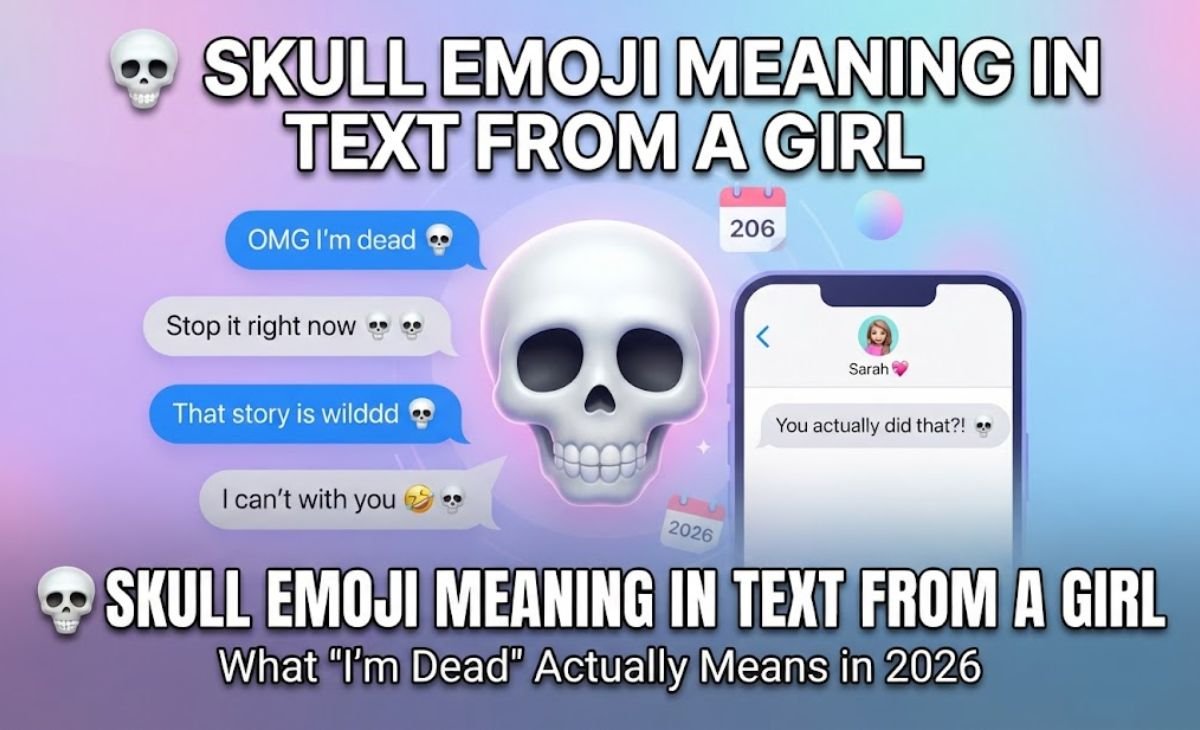
What Does 💀 Mean From a Girl?
When a girl texts you 💀, she almost always means “I’m dead” from laughing. Something you said was so funny, awkward or unexpected that she “died.” It is a stronger, more modern version of LOL or 😂. It rarely means anything dark, and it is usually a good sign that the chat is relaxed.
Skull Emoji Meaning in Text: Still, the same skull can mean laughter, cringe, shock or playful teasing. The difference is in the message that came before it. This guide shows you how to tell which one she means, whether it says anything about her interest in you, and what to reply.
💀 Emoji Meaning in General (For Anyone)
The 💀 emoji is officially called Skull (Unicode U+1F480). Its literal meaning is death, danger or something spooky. In everyday texting, though, it is used figuratively. Emojipedia describes it as figurative death, such as “dying from extreme laughter, frustration, or affection.”
Today, anyone who sends 💀 usually means one of these:
- “I’m dead” / “I’m dying”: something is extremely funny
- “I can’t”: cringe or second-hand embarrassment
- “I’m done”: shock, disbelief or being speechless
- “I’m finished”: tired, defeated or overwhelmed (“3 exams tomorrow 💀”)
- Literal use: Halloween, horror, pirates, danger or real talk about death
So the general meaning and the “from a girl” meaning are the same emoji. Girls do not use a secret version of it. What changes is the context: who sends it, what came before it, and how the rest of the chat feels.
you can read this article About “SYBAU Meaning in Texting: What Does SYBAU Mean on Social Media? (2026)”
7 Things 💀 Means When a Girl Sends It
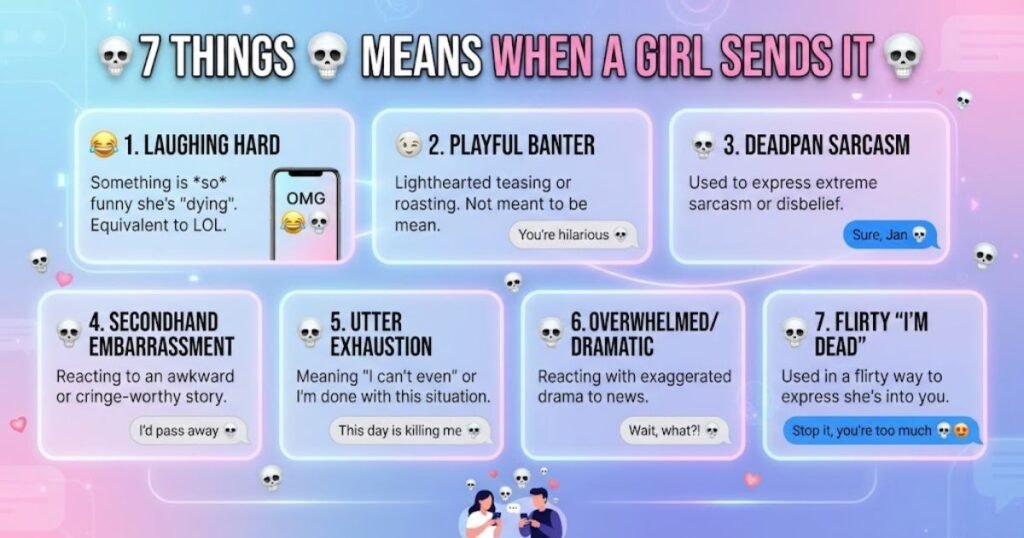
1. She is laughing hard
This is the meaning in most chats. 💀 has become the new 😂 for younger texters.
You: I tried to impress the barista and said “you too” when she said enjoy your coffee
Her: 💀💀
What it means: She found it genuinely funny.
2. She is cringing (second-hand embarrassment)
Sometimes 💀 means “I can’t watch this.” She is not laughing at you in a mean way. She is feeling the awkwardness with you.
You: I accidentally called my teacher “mom” in front of the whole class
Her: NOT THE TEACHER 💀
What it means: “That is so awkward, I feel it too.”
3. She is shocked or speechless
When something is too wild to answer in words, 💀 does the job.
You: My brother spent his whole salary on a gaming chair
Her: the WHOLE salary?? 💀
What it means: Disbelief, with a bit of humor.
4. She is teasing you
A skull after a light roast keeps it playful. It tells you she is joking, not insulting you.
You: I’m honestly a great cook
Her: you burned instant noodles last week 💀
What it means: Friendly roasting. People usually tease those they feel comfortable with.
5. She is laughing at herself
Girls often put 💀 after their own mistakes or bad luck.
Her: just walked into a glass door in front of my crush 💀
What it means: Self-roast. She is sharing something embarrassing because she trusts you with it.
6. She is tired or done
💀 can also mean exhausted, overwhelmed or “this day killed me.”
Her: 4 assignments due tomorrow and I haven’t started 💀
What it means: Stress, said in a funny way. A kind or encouraging reply works best here.
7. She is being dismissive (rare)
A lone 💀, with no words, as a reply to something you care about can mean “that was weird” or “I don’t know what to say.” This is uncommon. See the section on bad signs below to spot it.
How to Read Her 💀: A 5-Point Context Check
Most guides say “it depends on context” and stop there. Here is what context actually means. Look at these five clues before you decide what her skull means.
| Clue | Usually a good sign | Worth a second look |
|---|---|---|
| What came before it | A joke, a funny story, a mistake | Something serious or personal you shared |
| Words with it | “LMAO 💀”, “stoppp 💀”, “not you doing that 💀” | A lone 💀 and nothing else |
| Number of skulls | 💀💀 or 💀💀💀 (more = funnier) | One skull, every time, to everything |
| What she does next | She adds to the joke or asks a question | The chat goes quiet or she changes topic |
| Her normal texting style | She uses 💀 with everyone | She never uses it, then sends one after an awkward message |
Simple rule: If 💀 comes after something funny and she keeps talking, she is laughing. If it comes after something serious and the chat dies, she may be uncomfortable.
Does 💀 Mean She Likes You?
On its own, no. 💀 is a laughing emoji, not a flirting emoji. Girls send it to friends, siblings and group chats all day. But the way she uses it can tell you she enjoys talking to you.
Signs her 💀 is friendly or flirty:
- She laughs at your jokes often, even the average ones
- She teases you with 💀 and then keeps the chat going
- She sends you her own embarrassing stories with 💀
- She uses it with other playful emojis like 😭, 😮💨 or 😏
- She replies fast and starts conversations too
Signs it is just friendly:
- She uses 💀 the same way in group chats and public comments
- Her replies are short and she rarely asks you anything
If you want to know how she feels, look at the whole conversation, not one emoji. Effort, questions and reply speed say far more than a skull.
When 💀 Can Be a Bad Sign
Most of the time, 💀 is positive. Here are the few cases where it may not be:
- You shared something serious. If you opened up about a problem and she replied with only 💀, she may have misread the tone, or she may not know how to respond. Don’t assume the worst. A calm “haha I was actually kind of serious” usually clears it up.
- A dry, lone 💀 after a compliment or a move. If you asked her out or said something romantic and got back just 💀, she may be laughing it off to avoid an awkward no. Watch what she says next.
- 💀 plus sarcasm. “wow ok 💀” or “that’s crazy 💀” after a strong opinion can mean she disagrees or finds it odd.
- Mocking in a group chat. A skull aimed at someone in front of others can be a roast that goes too far.
If you are unsure, just ask in a relaxed way: “lol was that a good 💀 or a bad 💀?” It shows confidence and clears up the confusion.
💀 Emoji Combos and What They Mean
Top-ranking guides rarely explain combos, but girls often send 💀 with other emojis or words. Each combo changes the meaning slightly.
| Combo | Meaning | Example |
|---|---|---|
| 💀💀💀 | Extremely funny, she can’t breathe | “you did NOT say that 💀💀💀” |
| 💀😭 | Crying laughing, the strongest laugh reaction | “my dog ate my homework for real 💀😭” |
| 😭💀 | Same as above, slightly more emotional or “I can’t” | “why is this so true 😭💀” |
| LMAO 💀 / LMFAO 💀 | Big laugh, very positive | “LMAO 💀 stop” |
| lol 💀 | Light laugh, relaxed chat | “lol 💀 same” |
| not the ___ 💀 | Teasing you about a specific thing | “not the crocs 💀” |
| 💀✋ | “I’m dead, stop” or “I’m done” | “💀✋ I’m leaving this chat” |
| 💀🤡 | You (or she) did something silly | “me thinking I’d wake up early 💀🤡” |
| Just 💀 | Laughing, or speechless; check the context table above | — |
💀 vs ☠️ vs 😂 vs 😭: What’s the Difference?
These four get mixed up a lot. Here is how they compare in modern texting.
| Emoji | Name | Main meaning in texting | Feels like |
|---|---|---|---|
| 💀 | Skull | “I’m dead” laughing, cringe, shock | Gen Z, casual, very common |
| ☠️ | Skull and Crossbones | Danger, poison, pirates; sometimes used like 💀 | Rarer, more literal |
| 😂 | Face with Tears of Joy | Laughing | Seen as older or “millennial” by many Gen Z users |
| 😭 | Loudly Crying Face | Crying laughing, overwhelmed, or real sadness | Emotional, often paired with 💀 |
Key point: 💀 and 😂 mean nearly the same thing, but the skull feels more current. According to Wikipedia’s history of the emoji, Gen Z started seeing 😂 as “uncool” and switched to 💀. So if she sends 💀, she is just laughing in today’s language.
What 💀 Means on Each App
| App | How girls usually use 💀 |
|---|---|
| WhatsApp / iMessage | Replies to jokes, stories and memes in private chats |
| Snapchat | Reactions to snaps and story replies, often a lone 💀 |
| Comments on reels and memes; DMs replying to a shared reel | |
| TikTok | Comment sections, where 💀 is one of the most common reactions |
| Discord / gaming chats | Reacting to a fail, a bad play or a wild message |
| Dating apps (Tinder, Hinge, Bumble) | Laughing at your opener or bio, or light teasing; usually a good sign |
Tip for dating apps: If she replies to your opener with 💀 and a question, your joke landed. If she sends only 💀, keep the energy going with a playful follow-up rather than explaining the joke.
How to Reply When a Girl Sends 💀
Match her energy. Don’t over-explain, and don’t ask “why the skull?” unless you really can’t tell. Pick a reply based on the situation.
| Situation | What she means | Good replies |
|---|---|---|
| You told a joke | She’s laughing | “I knew you’d like that one 😭” / “glad I could kill you 💀” |
| She’s roasting you | Playful teasing | “wow ok, betrayed 💀” / “at least I tried 😭” |
| You shared an awkward story | Second-hand cringe | “I know, I’m never recovering 💀” |
| She roasted herself | She’s laughing at her own mistake | “no way 😭 are you okay?” / “legend behavior honestly” |
| She’s stressed (“exam tomorrow 💀”) | Tired, overwhelmed | “you’ve got this, want me to quiz you?” |
| Lone 💀 after something serious | Unsure how to respond | “haha I was actually kind of serious though” |
| Lone 💀 after you asked her out | Could be nervous or a soft no | “so is that a yes or a 💀 no? 😅” |
Avoid: replying with a long paragraph, taking the skull personally, or sending 💀 back with nothing else every time. A reply that adds a question keeps the chat alive.
Where the 💀 “I’m Dead” Meaning Came From
The skull is older than most people think:
- 1999: A skull first appeared on early Japanese emoji keyboards from SoftBank, per Emojipedia.
- 2010: The Skull emoji was approved as part of Unicode 6.0.
- 2015: It was added to Emoji 1.0. Around then, people used 👻 (ghost) for the “I’m dead” joke, according to Wikipedia.
- 2016: Wired reported people using 💀 to mean being “socially dead,” such as after breaking a phone.
- Early 2020s: Gen Z made 💀 the standard way to say “I’m dead” or “I’m dying” from laughter, replacing 😂, which they saw as uncool.
The idea behind it is simple. People have said “I’m dead” or “I’m dying” to mean “that’s hilarious” for years. The skull is just that phrase turned into one picture.
Learn more: Browse our complete texting abbreviations list with 100+ text slang meanings from A to Z.
Frequently Ask Questions About 💀 From a Girl
What does 💀 mean from a girl?
It usually means she is laughing so hard she’s “dead.” It can also show cringe, shock or playful teasing, depending on what you said before it.
Is the skull emoji flirty?
Not by itself. It becomes flirty when she uses it to tease you, laughs at your jokes often and keeps the conversation going.
Is the skull emoji rude?
Rarely. It can feel rude only as a lone reply to something serious or personal. In normal chats, it is friendly.
What does the crying skull combo mean from a girl?
It means she is crying with laughter. It is one of the strongest that’s-so-funny reactions.
What does triple skull emoji mean?
More skulls mean more laughter. Three skulls means she found it extremely funny.
Why do girls use the skull emoji instead of the crying-laughing face?
Many younger users see the crying-laughing face as outdated. The skull feels more current and more dramatic, so it has become the go-to laughing emoji.
What does the skull emoji mean from a guy?
The same thing. The skull has no gender-specific meaning. It means laughing, cringe or shock whoever sends it.
What should I reply when a girl sends the skull emoji?
Match her mood. Add to the joke, tease back lightly, or ask a follow-up question to keep the chat going.
Final Thoughts
When a girl sends you 💀, relax. In most chats, it simply means you made her laugh, or something was too awkward or wild for words. Read what came before it, notice whether she keeps talking, and reply in the same playful tone.
Got a confusing text? Paste the whole message into our free Slang Translator to read it in plain English, or look up any single term with the Abbreviation Decoder.

Rose Lily
I’m Rose Lily, a writer at MeaningFussion, where I explain Gen Z slang, texting abbreviations, social media terms, internet language, and trending expressions in simple words. I create easy-to-understand guides with meanings, examples, and real-life usage to help readers understand what people mean in texts, chats, TikTok, Instagram, Snapchat, and other online conversations.