
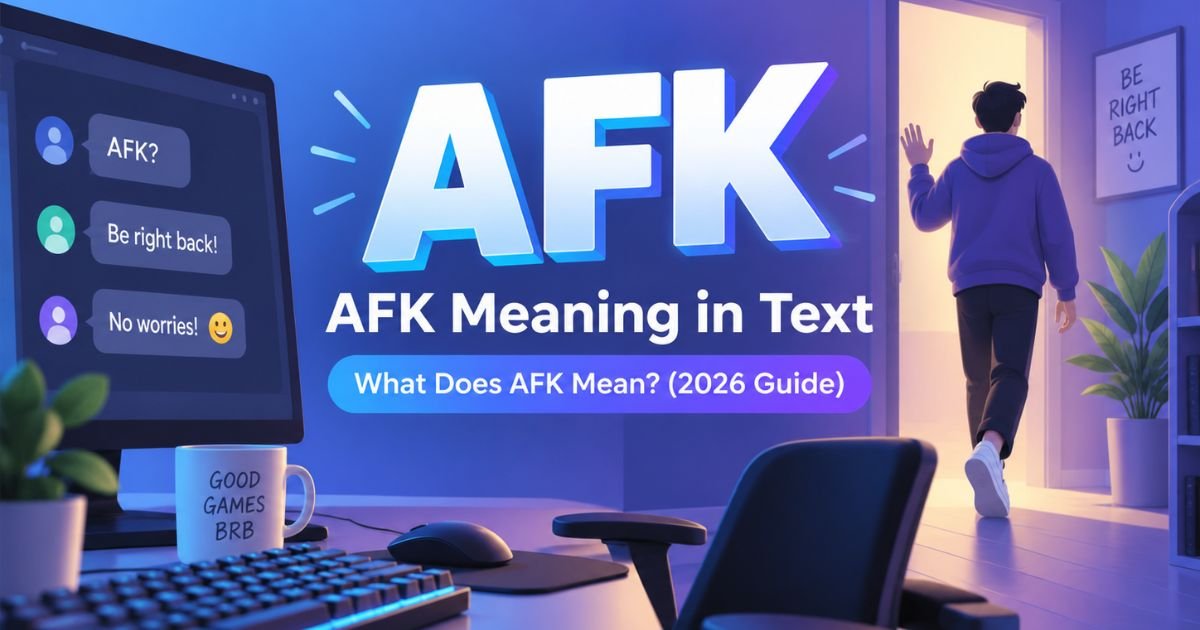
AFK means “Away From Keyboard.” People type AFK in texts, chats and online games to say they are stepping away for a while and won’t reply right away, for example: “AFK, back in 5.”
If you’ve ever been chatting online or playing a game and someone suddenly typed “AFK, back in 5,” you probably understood the general idea even without knowing the full form. AFK is one of the oldest and most widely used pieces of internet slang, and it’s still just as common in 2026 as it was decades ago.
In this guide, you’ll learn exactly what AFK means, where it came from, how people use it today in gaming, texting, and even at work, and how it’s different from similar terms like BRB and idle.
What Does AFK Mean?
AFK stands for “Away From Keyboard.” Some people also write it as “away from keys.” It’s used to tell others in a chat, game, or online conversation that you’re temporarily not available to respond.
When someone types AFK, they usually mean:
- They’re stepping away from their device for a short time
- They’re still logged in or connected, just not actively watching
- They’ll be back soon, even if no exact time is given
AFK is written in a few different ways, and all of them mean the same thing:
- AFK (capital letters, most common)
- afk (lowercase, casual chat)
- Afk (less common)
There’s no strict grammar rule here since it’s internet slang, so any of these forms works fine in a casual conversation.
Where Did AFK Come From? (Origin and History)

AFK Meaning isn’t a new term. It actually dates back to the early days of the internet.
The abbreviation started in Internet Relay Chat (IRC) rooms during the late 1980s and 1990s. Back then, people weren’t connected to the internet all day the way we are now, so typing “AFK” was a quick, polite way to let others in the chatroom know you were stepping away from your computer.
As online gaming grew, especially massively multiplayer online games (MMOs) like World of Warcraft, AFK became a gaming staple. Players used it to tell their team they were temporarily inactive without needing to log out completely.
Later, as instant messaging apps like AIM and Yahoo Messenger became popular, AFK Meaning turned into a status people could set to show they were online but not actively watching their screen. From there, it spread into everyday texting, social media, and even workplace chat tools.
You can read this article about “SYBAU Meaning in Texting: What Does SYBAU Mean on Social Media? (2026)“
How Is AFK Used Today?
AFK has grown far beyond gaming and chatrooms. Here’s how people commonly use it now.
AFK in Gaming
This is where AFK is most at home. Players type it in chat before stepping away so teammates aren’t caught off guard during a match or raid.
- “AFK for 5, need water.”
- “He went AFK during the match and never came back.”
Staying AFK too long in competitive games can sometimes lead to penalties, like being kicked from a match or losing rewards.
AFK Meaning in Texting and Social Media
Outside of gaming, AFK is common in group chats, DMs, and social apps like Instagram, WhatsApp, and Discord.
- “AFK for a bit, family just showed up.”
- “Sorry, I was AFK and missed your message.”
On social platforms, AFK doesn’t always mean someone is literally away from a keyboard. It usually just means they’re not actively checking their phone or app.
AFK Meaning at Work or in Casual Team Chats
In relaxed workplace tools like Slack or Microsoft Teams, AFK is sometimes used informally.
- “AFK for 10 mins, quick call.”
That said, it’s best kept for casual internal chats. It’s not appropriate for formal emails or client-facing communication.
AFK Meaning vs Similar Terms
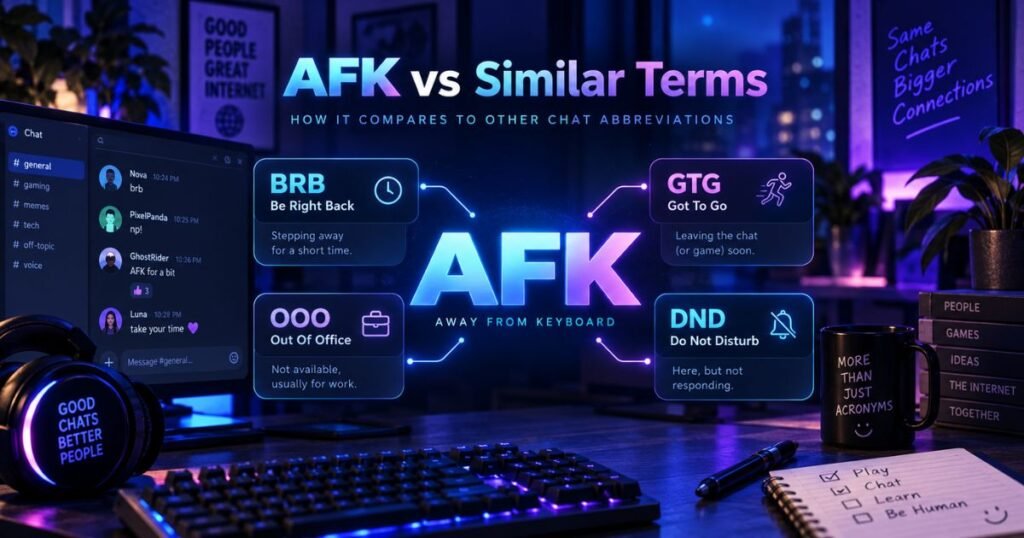
AFK is often confused with a few other internet abbreviations. Here’s how they compare:
| Term | Full Form | Meaning | Typical Use |
|---|---|---|---|
| AFK | Away From Keyboard | Temporarily unavailable, no fixed return time | Gaming, chats, texting |
| BRB | Be Right Back | Short absence with a quick, implied return | Chats, calls, gaming |
| Idle | — | System-detected inactivity (not typed by the user) | Messaging apps, games |
| DND | Do Not Disturb | Present but not open to messages | Work chats, apps |
| GTG | Got To Go | Leaving the conversation, possibly for good | Texting, chats |
The main difference between AFK and BRB is the sense of time. BRB signals you’ll be back very soon, while AFK can mean a shorter or longer absence with no exact timeframe. They’re often used together, as in “brb afk.”
How to Use AFK in a Sentence
AFK is flexible, so you can use it a few different ways:
- As a standalone status: Just type “AFK” to show you’re stepping away.
- To describe yourself: “I’ll be AFK for about 20 minutes.”
- To describe someone else: “She’s AFK, probably grabbing lunch.”
A few more examples for context:
- “Taking a call, AFK for a bit.”
- “I need to be AFK for ten minutes, don’t start without me.”
- “He’s such an AFK lately, always stepping away mid-game.”
Notice that last example: AFK can even work as a noun to describe someone who’s frequently away from their screen.
When Should You Avoid Using AFK?
AFK works well in informal settings, but it’s not suitable everywhere. Here’s a quick guide:
Good places to use AFK Meaning:
- Online games and gaming chat
- Group texts with friends
- Discord servers
- Casual social media captions or stories
Places to avoid AFK:
- Formal work emails
- Business meetings or client calls
- Academic writing or exams
- Professional presentations
In formal situations, it’s better to write out the full phrase, such as “I’ll step away for a few minutes and be right back.”
AFK Meaning at a Glance
| Question | Quick Answer |
|---|---|
| What does AFK stand for? | Away From Keyboard |
| Where did it originate? | IRC chatrooms in the 1990s |
| Is it formal or informal? | Informal, internet slang |
| Common alternative | BRB (Be Right Back) |
| Where is it most used? | Gaming, texting, social media, casual chats |
Learn more: Browse our complete texting abbreviations list with 100+ text slang meanings from A to Z.
Conclusion
AFK has come a long way from its roots in 1990s chatrooms, but its purpose hasn’t changed much: it’s still a quick, polite way to tell people you’re stepping away for a bit. Whether you’re deep in a gaming session, texting a friend, or chatting casually with coworkers, knowing when and how to use AFK helps you communicate clearly without any awkward silences.
Next time someone sends you “AFK, back soon,” you’ll know exactly what they mean, and now you can use it naturally yourself.
Frequently Asked Questions
Is AFK only used in gaming?
No. While AFK started in gaming and IRC chatrooms, it’s now common in texting, social media, and casual workplace chats too.
What’s the difference between AFK and BRB?
AFK usually signals unavailability with no set return time, while BRB implies you’ll be back very quickly.
Is it AFK or afk?
Both are correct. Capital letters are more common, but lowercase “afk” is just as acceptable in casual chats.
Can AFK be used as a noun?
Yes. People sometimes call someone “an AFK” if they’re frequently away from their keyboard during games or chats.
Is AFK appropriate for work emails?
No, it’s too informal for professional emails or client communication. Save it for casual internal chats instead.
How long can you stay AFK in a game without penalty?
It depends on the game, but many competitive games kick or penalize players after a few minutes of inactivity.
.
Got a confusing text? Paste the whole message into our free Slang Translator to read it in plain English, or look up any single term with the Abbreviation Decoder.

Rose Lily
I’m Rose Lily, a writer at MeaningFussion, where I explain Gen Z slang, texting abbreviations, social media terms, internet language, and trending expressions in simple words. I create easy-to-understand guides with meanings, examples, and real-life usage to help readers understand what people mean in texts, chats, TikTok, Instagram, Snapchat, and other online conversations.