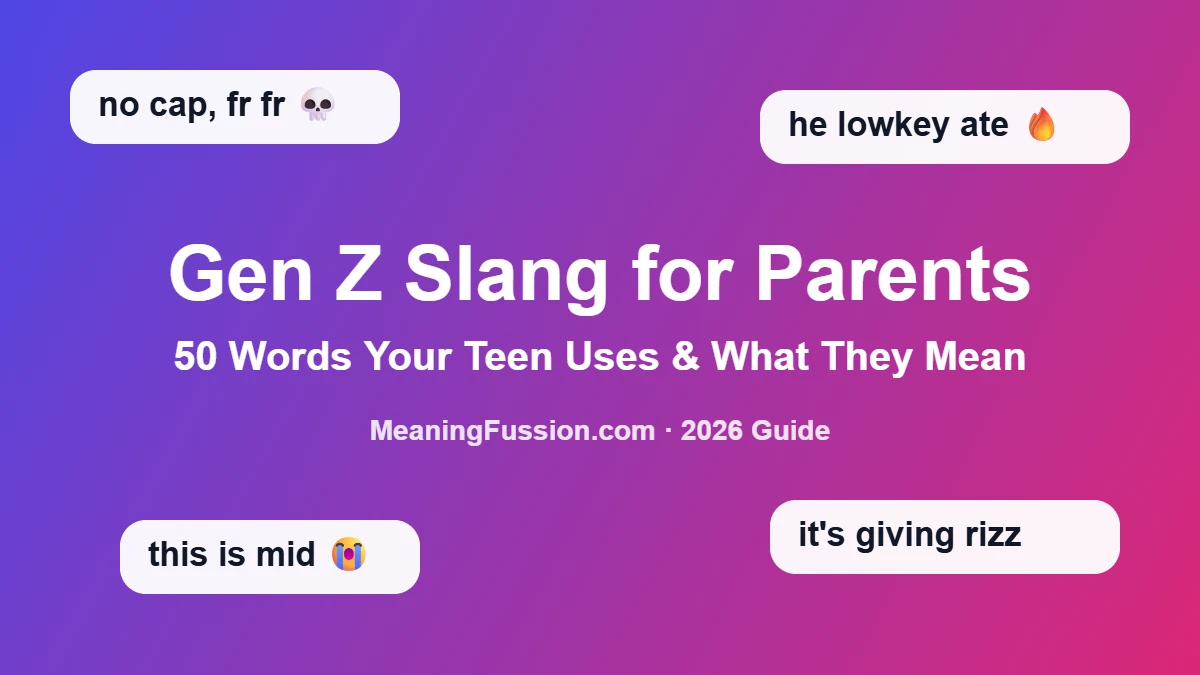
Your teen just texted “no cap, that test was mid 💀” and you have no idea if that is good news or bad news. You are not alone. This Gen Z slang for parents guide explains the 50 words teens use most in 2026, what they really mean, and, most importantly, which ones are harmless and which ones are worth a calm conversation.
Every word below comes with a plain-English meaning, a real-style text example, and a simple safety label. No judgment, no panic, just clear answers so you can understand your kids without feeling lost (or cringe).
What Is Gen Z Slang? (Quick Answer for Parents)
Gen Z slang is the informal language used by people born roughly between 1997 and 2012. It spreads fast through TikTok, YouTube, Snapchat, Discord and group chats. Most of it is playful: words for “cool,” “funny,” “embarrassing,” or “I agree.” A small part of it can point to drama, bullying or risky situations, which is why a simple safety key helps.
If you want the full A–Z list, see our Gen Z slang dictionary. This page is different: it is written for moms, dads, teachers and caregivers who want the meaning plus the context.
Why Parents Should Learn Teen Slang in 2026
- You understand their world. Slang carries jokes, moods and friendships. Knowing it helps you read the room.
- You spot real warning signs. Most words are harmless, but a few can hint at bullying, secret accounts or emotional stress.
- You avoid overreacting. Many words sound rude or scary but are just jokes. “I’m dead 💀” usually means “that is so funny.”
- You build trust. Teens open up more when parents are curious instead of critical.
How to Read This Gen Z Slang for Parents Guide
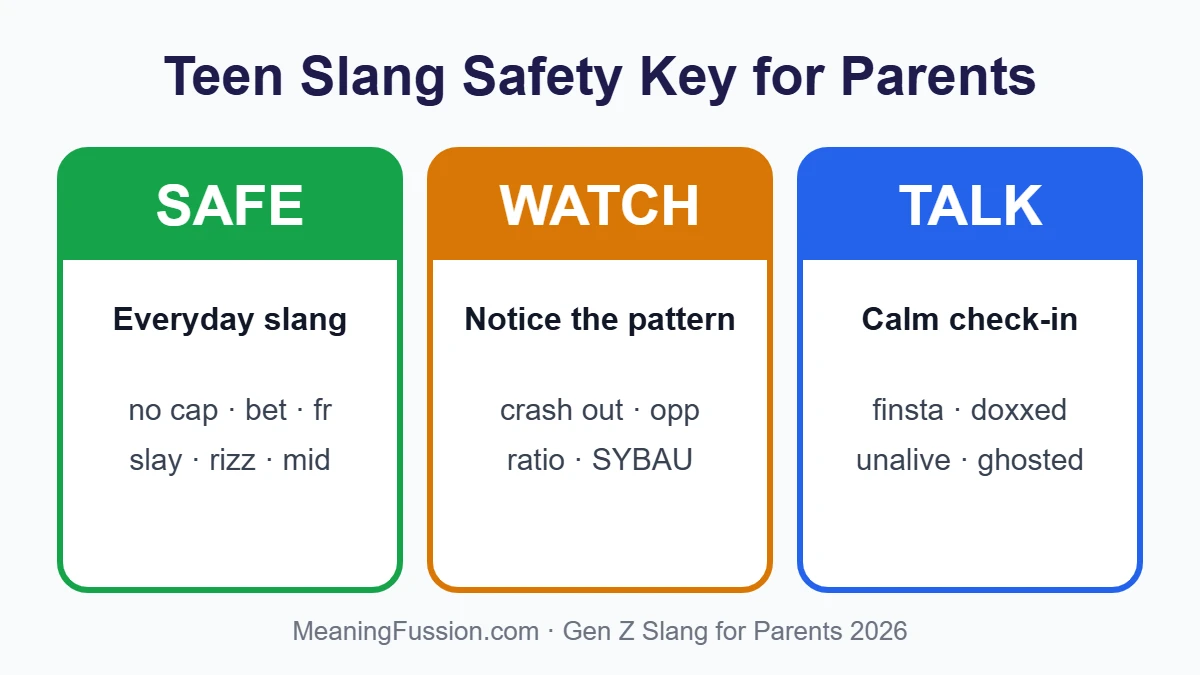
Each word has one of three labels. We based them on how teens actually use the words online in 2026, not on how scary they sound:
| Label | What It Means for You |
|---|---|
| ✅ Safe | Everyday slang. Normal, playful, nothing to worry about. |
| ⚠️ Watch | Usually fine, but can be rude, mean or a sign of conflict. Notice the pattern, not one message. |
| 💬 Talk | Worth a gentle, calm conversation if it shows up often or is about your teen personally. |
Everyday Gen Z Words Parents Hear Most (1–15)
These are the words you will see in almost every teen group chat. They mostly mean “really,” “yes,” “okay” or “honestly.”
| Slang | What It Means | Example | Should You Worry? |
|---|---|---|---|
| 1. No cap | No lie; for real | “No cap, this pizza is the best.” | ✅ Safe |
| 2. Cap / 🧢 | A lie; fake | “He said he finished his homework. Cap.” | ✅ Safe |
| 3. Fr / fr fr | For real (agreement or emphasis) | “I’m so tired fr fr.” | ✅ Safe |
| 4. Bet | Okay; deal; sounds good | “Pick me up at 5?” “Bet.” | ✅ Safe |
| 5. Ngl | Not gonna lie | “Ngl, that movie was good.” | ✅ Safe |
| 6. Istg | I swear to God (strong emphasis) | “Istg I’m never eating that again.” | ✅ Safe |
| 7. Lowkey | Slightly; secretly | “I lowkey like this song.” | ✅ Safe |
| 8. Highkey | Very; openly | “I highkey need a nap.” | ✅ Safe |
| 9. Period | End of discussion; strong agreement | “She’s the best singer. Period.” | ✅ Safe |
| 10. It’s giving… | It looks like / has the vibe of | “Your outfit? It’s giving movie star.” | ✅ Safe |
| 11. Bruh | Disbelief or “seriously?” | “Bruh, the Wi-Fi is down again.” | ✅ Safe |
| 12. Sus | Suspicious; shady | “That link looks sus.” | ✅ Safe |
| 13. ATP | At this point | “ATP I’ll just start over.” | ✅ Safe |
| 14. IKR | I know, right? | “This weather is crazy.” “IKR.” | ✅ Safe |
| 15. Dead / I’m dead | That is extremely funny | “Your dog in that hat 😭 I’m dead.” | ✅ Safe |
Praise and Hype Words: When Your Teen Is Impressed (16–25)
Good news: a lot of Gen Z slang is positive. If your teen says one of these about you, take it as a compliment.
| Slang | What It Means | Example | Should You Worry? |
|---|---|---|---|
| 16. Slay | Did something amazingly well | “You slayed that presentation!” | ✅ Safe |
| 17. Ate / ate that | Did it perfectly | “Mom ate with that birthday cake.” | ✅ Safe |
| 18. Bussin | Delicious; really good | “These tacos are bussin.” | ✅ Safe |
| 19. GOAT | Greatest of all time | “Messi is the GOAT.” | ✅ Safe |
| 20. Rizz | Charm; flirting skill | “He has so much rizz.” | ✅ Safe |
| 21. Aura | Coolness points; reputation | “Tripping in class? Minus 1000 aura.” | ✅ Safe |
| 22. Aura farming | Acting cool on purpose to look impressive | “He’s aura farming in every photo.” | ✅ Safe |
| 23. Glow up | A big positive change in looks or confidence | “Her glow up this year is crazy.” | ✅ Safe |
| 24. Main character | Acting like the star of your own movie | “Walking in the rain with headphones = main character energy.” | ✅ Safe |
| 25. Rent free | Can’t stop thinking about it | “That song lives in my head rent free.” | ✅ Safe |
Feelings, Drama and Teasing Words (26–37)
This group is where context matters. Most of these are jokes between friends, but a few can show stress, conflict or unkind behavior when they show up again and again.
| Slang | What It Means | Example | Should You Worry? |
|---|---|---|---|
| 26. Mid | Average; not impressive | “The new phone is kinda mid.” | ✅ Safe |
| 27. Cooked | In big trouble; doomed (usually joking) | “I forgot the test was today. I’m cooked.” | ✅ Safe |
| 28. Delulu | Delusional; unrealistic hopes | “Thinking I’ll pass without studying is delulu.” | ✅ Safe |
| 29. Ick | Something that instantly turns you off | “Chewing loudly is the ick.” | ✅ Safe |
| 30. Touch grass | Go outside; take a break from screens | “You’ve been gaming for 8 hours. Touch grass.” | ✅ Safe |
| 31. Brainrot | Silly, low-quality content (or the feeling of watching too much) | “I watched brainrot videos all night.” | ⚠️ Watch (screen time) |
| 32. Crash out | Lose your temper; act out badly | “He crashed out after losing the game.” | ⚠️ Watch |
| 33. Simp | Someone who tries too hard to impress a crush | “Stop simping and text her back.” | ⚠️ Watch (teasing) |
| 34. NPC | Someone acting boring or robotic | “He’s such an NPC.” | ⚠️ Watch (can be mean) |
| 35. Ratio | When a reply gets more likes than the original post | “He got ratioed so bad.” | ⚠️ Watch (online pile-ons) |
| 36. Opp | An opponent; someone seen as an enemy | “Don’t talk to him, he’s an opp.” | ⚠️ Watch (conflict) |
| 37. Situationship | A romantic relationship with no clear label | “It’s not dating, it’s a situationship.” | 💬 Talk (age-dependent) |
Texting Abbreviations Every Parent Should Know (38–45)
Teens shorten almost everything. These abbreviations are mostly harmless and show up in normal daily chats. For 100+ more, see our texting abbreviations list.
| Slang | What It Means | Example | Should You Worry? |
|---|---|---|---|
| 38. WYD | What (are) you doing? | “wyd later?” | ✅ Safe |
| 39. HYD | How (are) you doing? | “hey hyd” | ✅ Safe |
| 40. LMK | Let me know | “LMK if you need a ride.” | ✅ Safe |
| 41. OOMF | One of my followers / friends | “oomf just posted the cutest pic” | ✅ Safe |
| 42. IJBOL | I just burst out laughing | “IJBOL at your text 😭” | ✅ Safe |
| 43. SYBAU | A rude way to say “be quiet” | “sybau 😒” | ⚠️ Watch (rude) |
| 44. IDGAF | “I don’t care” with a swear word | “idgaf what they think” | ⚠️ Watch (profanity) |
| 45. PMO | “That annoys me” (contains a swear word) | “This homework pmo” | ⚠️ Watch (profanity) |
Gen Z Slang for Parents: Words Worth a Calm Talk (46–50)
These words are not automatically bad. But if they show up often, are directed at your teen, or appear with changes in mood or sleep, a gentle check-in is a good idea.
| Slang | What It Means | Example | Should You Worry? |
|---|---|---|---|
| 46. Finsta | A “fake” or private second Instagram account | “Follow my finsta, it’s just close friends.” | 💬 Talk (privacy & safety) |
| 47. Gyat | A loud reaction to someone’s body | “GYAT 😳” under a photo | ⚠️ Watch (body comments) |
| 48. Ghosted | Someone suddenly stopped replying | “She ghosted me after the party.” | 💬 Talk if it hurts them |
| 49. Unalive | A filter-safe word for death or self-harm | Used in videos to avoid content filters | 💬 Talk if used about themselves |
| 50. Doxxed | Someone posted private info (address, phone, school) online | “They doxxed him in the group chat.” | 💬 Talk (online safety) |
Important: If your teen ever uses words like “unalive” about themselves, stay calm, listen without judgment, and reach out to a doctor, school counselor or local helpline for support. You don’t need perfect words, you just need to be there.
Gen Z Slang for Parents by Age: What Kids Say at 10, 13 and 16
Teen slang changes with age. A 10-year-old and a 16-year-old may use completely different words, so it helps to know what is normal for each stage. Use this Gen Z slang for parents age guide as a rough map, not a strict rule.
Ages 9–12 (Tweens)
Tweens pick up slang from YouTube, Roblox and Minecraft videos. Expect playful, meme-based words like skibidi, sus, rizz, aura, NPC, GOAT and “it’s giving.” These are almost always harmless. The main thing to watch at this age is screen time and who they chat with in games.
Ages 13–15 (Young Teens)
Young teens move to TikTok, Snapchat and group chats, and their teen slang grows fast: no cap, fr, bet, mid, cooked, delulu, ick and lots of abbreviations like WYD and LMK. This is also the age when teasing words (simp, NPC, ratio) and the first private accounts can appear. Stay curious and keep conversations light.
Ages 16–18 (Older Teens)
Older teens use slang more casually and switch it on and off depending on who they talk to. Words about relationships (situationship, ghosted, rizz) and stronger language (IDGAF, PMO) are more common. At this stage, respect their privacy but keep the door open for honest talks about friendships, dating and online safety.
Parent tip: If a word in a text confuses you, search it on MeaningFussion first before reacting. Most Gen Z slang for parents sounds stranger than it really is.
Emoji Meanings Parents Often Get Wrong
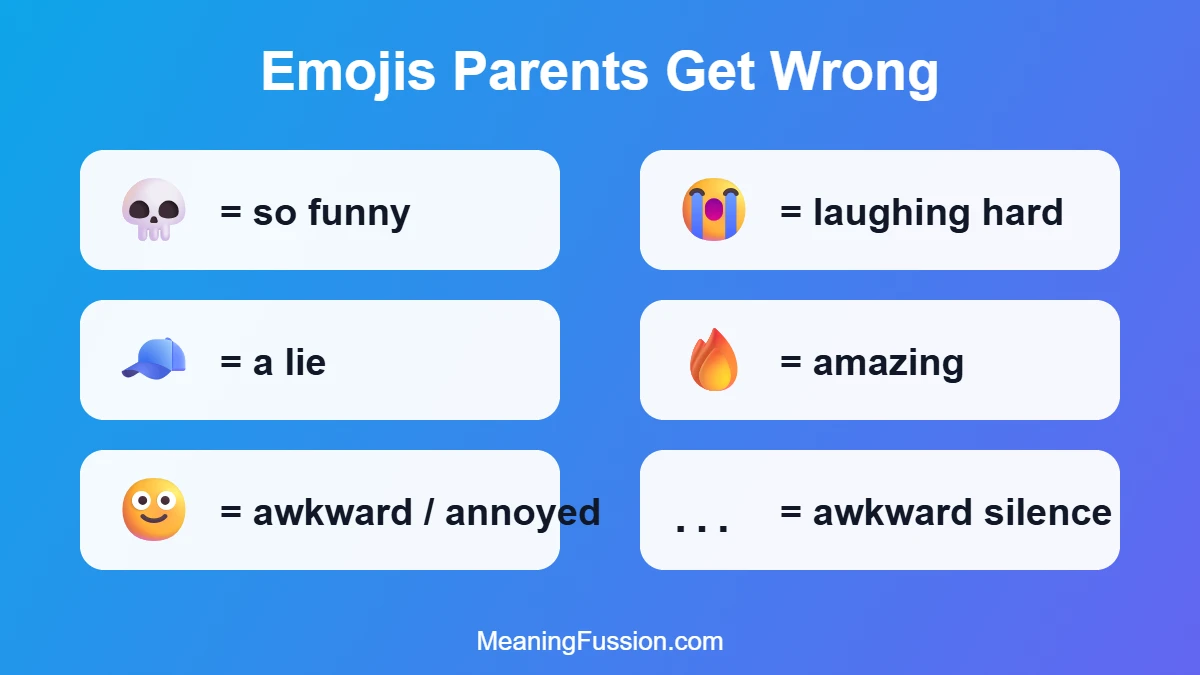
Emojis are part of teen slang too, and many don’t mean what adults think. Here are the ones that confuse parents the most:
| Emoji | What Adults Think | What Teens Usually Mean |
|---|---|---|
| 💀 Skull | Death or danger | “I’m dying of laughter.” See our skull emoji meaning guide. |
| 😭 Loudly crying | They are sad | Usually laughing hard or “this is too cute.” |
| 🧢 Blue cap | A hat | “That’s a lie” (cap). |
| 🔥 Fire | Something is burning | Something is amazing or attractive. |
| 🙂 Slight smile | Happy | Often passive-aggressive or awkward. |
| … Three dots | Thinking | Can mean awkward silence or disapproval. Read our three dots meaning guide. |
How to Talk to Your Teen About Slang (Without Being Cringe)
Knowing the words is only half the job. How you use that knowledge matters more. These tips come from what actually works with teens:
- Ask, don’t quiz. “What does ‘aura’ mean? I keep hearing it” feels friendly. “Explain this text right now” feels like an interrogation.
- Don’t overuse their slang. Using one word with a smile is funny. Using ten in every sentence is “cringe” and can shut the conversation down.
- Focus on patterns, not single words. One rude abbreviation is normal. Daily insults, secret accounts or sudden mood changes are worth noticing.
- Stay calm with scary-sounding words. “I’m dead,” “I’m cooked” and 💀 are almost always jokes. Reacting with panic teaches teens to hide things.
- Keep the door open. End talks with “You can always tell me anything, I won’t freak out.” Then keep that promise.
For more family-friendly advice on kids, screens and online safety, Common Sense Media has useful age-based guides for parents.
Where Does Teen Slang Come From?
Most Gen Z slang comes from three places: gaming culture (NPC, GOAT, ratio), online creators and memes (rizz, aura, brainrot), and older slang that teens remix (bet, sus, cap). Many words started in African American Vernacular English and spread through music and social media. A word can go from one viral video to every middle school in a few weeks, then fade just as fast.
Language experts track this too: dictionaries like Merriam-Webster now add internet slang every year. If you are curious about how slang works as a whole, read our guide to the types of slang.
Gen Z Slang for Parents: Quick Cheat Sheet
Short on time? Save or screenshot this mini cheat sheet of teen slang meanings:
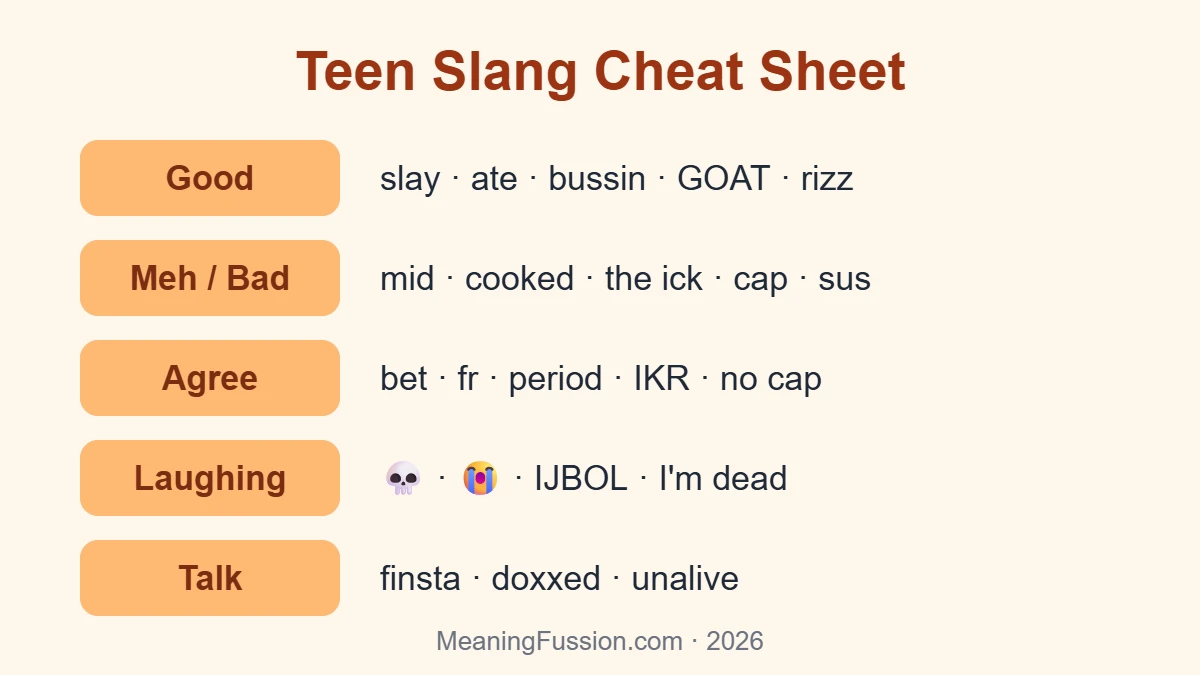
- Good: slay, ate, bussin, GOAT, rizz, glow up, fire 🔥
- Bad / meh: mid, cooked, the ick, cap, sus
- Agreeing: bet, fr, period, IKR, no cap
- Laughing: 💀, 😭, IJBOL, I’m dead
- Notice if frequent: crash out, opp, ratio, SYBAU, IDGAF
- Worth a talk: finsta, unalive, doxxed, ghosted (if it hurts)
FAQs About Gen Z Slang for Parents
What is the most common Gen Z slang word in 2026?
Words like “no cap,” “fr,” “aura,” “cooked,” “mid” and “rizz” are some of the most used Gen Z slang words in 2026, especially on TikTok and in group chats.
Should parents use Gen Z slang with their kids?
A little is fine and can be funny. Overusing it usually feels “cringe” to teens. It is better to understand the words than to copy them.
What teen slang words should parents worry about?
Most slang is harmless. Pay attention to words linked to secret accounts (finsta), online conflict (opp, ratio, doxxed) or self-harm (unalive), especially if they appear often or are about your teen.
What does the skull emoji mean from a teenager?
The 💀 emoji almost always means “I’m dying of laughter.” It is a joke, not a threat or a sad message.
What does “no cap” mean?
“No cap” means “no lie” or “for real.” Teens use it to show they are being honest.
Where do teens learn new slang?
Mostly from TikTok, YouTube, Snapchat, Discord, video games and friends at school. New words can spread nationwide in a few weeks.
How can I keep up with new Gen Z slang?
Ask your teen, check a trusted slang dictionary, and follow updated guides like the MeaningFussion Gen Z slang dictionary, which is refreshed as new words trend.
Final Thoughts
You don’t need to be fluent in teen slang to be a great parent. You just need to be curious, calm and available. Use this Gen Z slang for parents guide whenever a text confuses you, and remember: most of the time, “I’m cooked 💀” just means your teen forgot their homework, not that something is wrong.
Want to keep learning? Explore our Gen Z meaning in text guide or browse old slang words to see how slang from your own teen years compares.

Rose Lily
I’m Rose Lily, a writer at MeaningFussion, where I explain Gen Z slang, texting abbreviations, social media terms, internet language, and trending expressions in simple words. I create easy-to-understand guides with meanings, examples, and real-life usage to help readers understand what people mean in texts, chats, TikTok, Instagram, Snapchat, and other online conversations.