Written by Rose Lily · Last updated: October 10, 2026
Old slang words are informal words and phrases that were popular in past decades but are rarely used today, like “the bee’s knees” (1920s), “groovy” (1960s), “rad” (1980s), and “as if” (1990s). Each era had its own slang, and many of these words tell a fun story about the music, movies, and culture of their time.
In this guide, you’ll find 100 old slang words sorted by decade, from the 1800s to the 2000s. Every word comes with a simple meaning, a real example sentence, and (where it fits) the modern Gen Z word that means the same thing today.
Quick Answer: The most famous old slang words are the bee’s knees and the cat’s pajamas (1920s), hep cat (1940s), daddy-o (1950s), groovy and far out (1960s), dy-no-mite (1970s), rad and tubular (1980s), and as if and da bomb (1990s). Most of them meant “cool,” “great,” or “no way.”
Table of Contents
- What Are Old Slang Words?
- Top 20 Old Slang Words (Quick Table)
- 1800s & Victorian Slang
- 1920s Slang
- 1930s & 1940s Slang
- 1950s Slang
- 1960s Slang
- 1970s Slang
- 1980s Slang
- 1990s Slang
- 2000s Slang
- Old Slang vs. Gen Z Slang
- Old Slang Words That Came Back
- Why Slang Goes Out of Style
- Funny Old Slang Insults
- How to Use Old Slang Today
- FAQs
What Are Old Slang Words?
Slang is casual language that a group of people creates to sound fresh, funny, or “in the know.” Old slang words are the slang terms from earlier generations. They were cool once, but most of them sound old-fashioned or even silly now. If you want to learn how slang works in general, read our complete guide to the types of slang.
Slang usually comes from:
- Music: Jazz musicians gave us hep, dig, and cool.
- Movies and TV: As if (Clueless) and dy-no-mite (Good Times) became famous on screen.
- Youth culture: Flappers, beatniks, hippies, surfers, and Valley Girls all created their own words.
- The military: Soldiers in World War II spread words like snafu around the world.
- The internet: Online gamers created noob and pwned in the 2000s.
Historians still study old slang today. Dictionaries like Green’s Dictionary of Slang track when each word first appeared, and Francis Grose’s 1811 Dictionary of the Vulgar Tongue is one of the oldest slang dictionaries you can still read for free.
Top 20 Old Slang Words and Their Meanings (Quick Table)
Short on time? Here are the 20 most popular old slang words, the decade they come from, and what people would say today instead.
| Old Slang Word | Decade | Meaning | Today We Say… |
|---|---|---|---|
| The bee’s knees | 1920s | Excellent, the best | It’s a 10 / goated |
| The cat’s pajamas | 1920s | Amazing, wonderful | Slaps |
| Swell | 1920s | Great, very good | Fire |
| Applesauce | 1920s | Nonsense | Cap |
| Hep cat | 1930s–40s | A stylish, in-the-know person | Main character |
| Killer-diller | 1940s | Something outstanding | Hits different |
| Daddy-o | 1950s | A friendly name for a man | Bro |
| Square | 1950s | A boring, old-fashioned person | Basic |
| Groovy | 1960s | Cool, excellent | Vibes |
| Far out | 1960s | Amazing, mind-blowing | Insane |
| Bummer | 1960s | A disappointment | L / that’s rough |
| Dy-no-mite | 1970s | Fantastic | Fire |
| Catch you on the flip side | 1970s | See you later | Ttyl |
| Rad | 1980s | Cool, awesome | Lit |
| Gag me with a spoon | 1980s | That’s gross | Ick |
| Bogus | 1980s | Fake, unfair | Cap |
| As if! | 1990s | No way, never | Not happening |
| Da bomb | 1990s | The best | GOAT |
| Talk to the hand | 1990s | I’m not listening | Sybau |
| Fetch | 2000s | Cool (from Mean Girls) | Slay |
Old Slang Words from the 1800s and Victorian Era
Popular 1800s and Victorian slang words include absquatulate, sawbones, gigglemug, bricky, saucebox, and bags o’ mystery.
Victorian slang was colorful and often very creative. Many of these words come from the 1909 book Passing English of the Victorian Era by J. Redding Ware.
- Absquatulate – To leave suddenly; to run off (an American joke word from the 1830s).
Example: “It got late, so I had to absquatulate before dinner.” - Sawbones – A doctor or surgeon (used by Charles Dickens in 1837).
Example: “You cut your hand badly—go see the sawbones.” - Gigglemug – A face that is always smiling.
Example: “Look at that gigglemug—he must have good news.” - Afternoonified – Smart, stylish, and fashionable.
Example: “She looked very afternoonified at the party.” - Bricky – Brave and bold.
Example: “That was a bricky thing to do, standing up to the bully.” - Bags o’ mystery – Sausages (because nobody knew what was inside).
Example: “We had bags o’ mystery for breakfast.” - Take the egg – To win the prize (like “take the cake”).
Example: “Your cake recipe really takes the egg.” - Shoot into the brown – To fail or miss your target.
Example: “I studied all night but still shot into the brown on the test.” - Saucebox – A cheeky, talkative person.
Example: “Don’t be such a saucebox to your teacher.” - Mafficking – Celebrating wildly in the streets (from the 1900 victory at Mafeking).
Example: “The whole town was mafficking after the win.” - Hunky-dory – Everything is fine (from the 1860s).
Example: “Don’t worry, everything is hunky-dory.” - Nifty – Clever or stylish (from the 1860s).
Example: “That’s a nifty little gadget.”
1920s Slang Words (The Roaring Twenties)
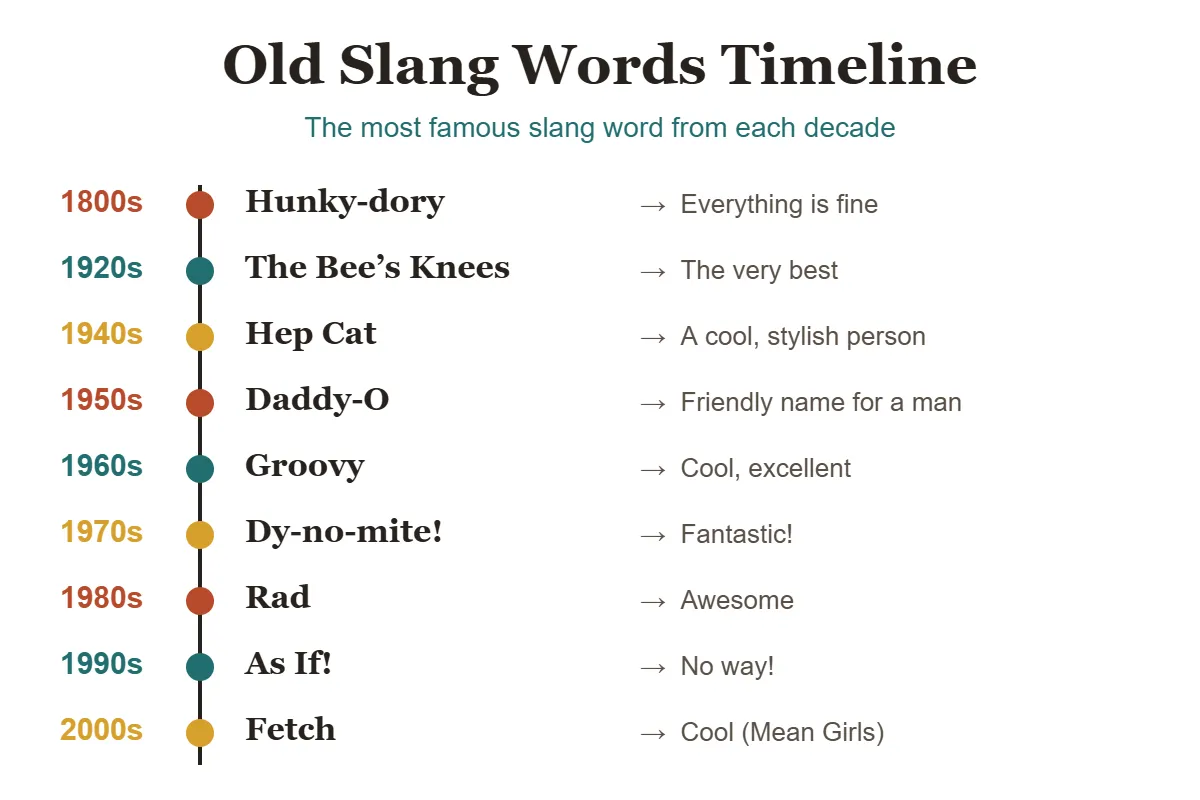
The most popular 1920s slang words were the bee’s knees, the cat’s pajamas, swell, ritzy, applesauce, horsefeathers, and big cheese.
The 1920s were the age of jazz, flappers, and fast fun. Young people invented tons of slang to sound modern, and many old slang words from this decade are still famous today.
- The bee’s knees – Something excellent or the very best.
Example: “This new jazz record is the bee’s knees!” - The cat’s pajamas / the cat’s meow – Amazing or wonderful.
Example: “Her dance moves are the cat’s pajamas.” - Swell – Great, very good.
Example: “We had a swell time at the fair.” - Ritzy – Fancy and expensive (named after the Ritz hotels).
Example: “They went to a ritzy restaurant downtown.” - Applesauce – Nonsense; a lie.
Example: “He says he met the president? Applesauce!” - Horsefeathers – Nonsense; rubbish.
Example: “Horsefeathers! I never said that.” - Hotsy-totsy – Just right; pleasing.
Example: “Everything at the party was hotsy-totsy.” - Big cheese – An important person; the boss.
Example: “Be polite—he’s the big cheese around here.” - Dewdropper – A lazy young man who sleeps all day and doesn’t work.
Example: “Get a job, you dewdropper!” - Bank’s closed – A flapper’s way of saying “no kissing.”
Example: “Sorry, pal, the bank’s closed.” - Baloney – Nonsense.
Example: “That excuse is pure baloney.”
1930s and 1940s Slang Words (Swing and War Years)
The most popular 1930s and 1940s slang words were hep cat, dig, in the groove, killer-diller, jitterbug, copacetic, and hubba hubba.
Swing music and World War II shaped the slang of this era. Jazz musicians gave us words like dig and hep, and soldiers spread military slang across the world.
- Hep cat – A cool, stylish person who knows about jazz and trends.
Example: “Your uncle was a real hep cat in his day.” - Dig – To understand or to like something.
Example: “I dig your new jacket.” - In the groove – Doing something really well; feeling the music.
Example: “The band is really in the groove tonight.” - Killer-diller – Something outstanding or exciting.
Example: “That trumpet solo was a killer-diller!” - Jitterbug – A wild swing dance, or a person who loves it.
Example: “Let’s jitterbug all night.” - Copacetic – Fine, satisfactory, all good.
Example: “Is everything copacetic with the plan?” - On the beam – On the right track (from airplane radio beams).
Example: “Your guess is right on the beam.” - Hubba hubba – Said when you see someone attractive.
Example: “Hubba hubba, look at that sharp suit!” - Snafu – A big mess or mix-up (a World War II military acronym).
Example: “The travel plans turned into a total snafu.” - Gobbledygook – Confusing language that’s hard to understand (coined in 1944 by U.S. congressman Maury Maverick).
Example: “This contract is full of gobbledygook.”
1950s Slang Words (Rock ’n’ Roll and Beatniks)
The most popular 1950s slang words were daddy-o, square, made in the shade, cruisin’ for a bruisin’, burn rubber, pad, and party pooper.
The 1950s brought rock ’n’ roll, drive-in movies, and hot rods. Beatniks and greasers each had their own way of talking.
- Daddy-o – A friendly name for a man, like “dude.”
Example: “What’s happening, daddy-o?” - Square – A boring, old-fashioned person.
Example: “Don’t be a square—come to the dance!” - Made in the shade – Success is guaranteed; life is easy.
Example: “With that new job, you’ve got it made in the shade.” - Cruisin’ for a bruisin’ – Looking for trouble.
Example: “Keep talking like that and you’re cruisin’ for a bruisin’.” - Burn rubber – To drive away very fast.
Example: “He hopped in his car and burned rubber.” - Pad – Your home or apartment.
Example: “Come over to my pad after school.” - Party pooper – Someone who ruins the fun.
Example: “Don’t be a party pooper—stay a little longer.” - Ginchiest – The coolest (made famous by the TV show 77 Sunset Strip).
Example: “That jukebox is the ginchiest!” - Cool it – Calm down.
Example: “Cool it, guys—the teacher is coming.”
1960s Slang Words (The Hippie Era)
The most popular 1960s slang words were groovy, far out, outta sight, bummer, fab, happening, and gimme some skin.
The 1960s were all about peace, love, and rock music. Hippies turned everyday words into new slang that still sounds “retro” today.
- Groovy – Cool, excellent, pleasant.
Example: “This music is so groovy.” - Far out – Amazing or mind-blowing.
Example: “You saw the Beatles live? Far out!” - Outta sight – Excellent; beyond expectations.
Example: “The concert was outta sight.” - Bummer – A disappointment or bad experience.
Example: “The show got canceled? What a bummer.” - Fab – Fabulous (made popular by the “Fab Four”—the Beatles).
Example: “Your new haircut looks fab.” - Happening – Exciting or trendy.
Example: “That club is the happening place tonight.” - The Man – The government, the boss, or people in power.
Example: “He says he won’t let the Man control him.” - Gimme some skin – Give me a handshake or high five.
Example: “Nice job, man—gimme some skin!” - Bread – Money.
Example: “I can’t go to the movies—I’m out of bread.” - Flower power – The hippie idea of peace and love instead of war.
Example: “Their van was covered in flower power stickers.”
1970s Slang Words (The Disco Decade)
The most popular 1970s slang words were dy-no-mite, can you dig it, right on, catch you on the flip side, keep on truckin’, foxy, and funky.
Disco, funk, and TV sitcoms ruled the 1970s. Many 70s slang words came from music and television catchphrases.
- Dy-no-mite! – Fantastic! (made famous by J.J. on the TV show Good Times in 1974).
Example: “You got an A on the test? Dy-no-mite!” - Can you dig it? – Do you understand? Do you agree?
Example: “We’re going to win this game—can you dig it?” - Right on – I agree; well said.
Example: “You want pizza tonight? Right on!” - Catch you on the flip side – See you later (like flipping a record to side B).
Example: “I’m heading home—catch you on the flip side.” - Keep on truckin’ – Keep going; don’t give up.
Example: “Tough week? Just keep on truckin’.” - Foxy – Attractive and stylish.
Example: “You look foxy in those platform shoes.” - Funky – Cool, groovy, or full of rhythm.
Example: “This song has a funky beat.” - Boogie – To dance, or to leave quickly.
Example: “Let’s boogie on the dance floor.” - Solid – Cool; I agree.
Example: “Meet at seven? Solid.”
1980s Slang Words (Totally Radical!)
The most popular 1980s slang words were rad, tubular, gnarly, gag me with a spoon, grody to the max, bodacious, bogus, and take a chill pill.
The 1980s gave us surfer slang, Valley Girl talk, and big hair. Frank Zappa’s 1982 song “Valley Girl” made a lot of these words famous across America.
- Rad / radical – Cool, awesome.
Example: “That skateboard trick was so rad!” - Tubular – Awesome (from surfers riding inside a wave’s “tube”).
Example: “The waves today are totally tubular.” - Gnarly – Extreme—can mean really cool or really gross.
Example: “That wipeout was gnarly, dude.” - Gag me with a spoon – That’s disgusting.
Example: “He eats pizza with ketchup? Gag me with a spoon!” - Grody to the max – Extremely gross.
Example: “The school cafeteria food is grody to the max.” - Bodacious – Awesome, impressive.
Example: “That guitar solo was bodacious.” - Bogus – Fake or unfair.
Example: “Getting detention for that is so bogus.” - Take a chill pill – Calm down; relax.
Example: “It’s only a game—take a chill pill.” - Wicked – Very (popular in New England).
Example: “That movie was wicked good.” - Cool beans – Great, sounds good.
Example: “We’re getting ice cream? Cool beans!”
Want more ways to say it? See our list of slang words for cool and slang words for awesome.
1990s Slang Words (As If!)
The most popular 1990s slang words were as if, talk to the hand, all that and a bag of chips, da bomb, phat, booyah, not!, and psych!
90s slang came from hip-hop, sitcoms, and teen movies like Clueless (1995). Many millennials still use these words today—usually as a joke.
- As if! – No way; that will never happen.
Example: “Me, go out with him? As if!” - Talk to the hand – I’m not listening to you.
Example: “Talk to the hand, ’cause the face ain’t listening.” - All that and a bag of chips – Someone who thinks they are amazing (or really is).
Example: “She thinks she’s all that and a bag of chips.” - Da bomb – The best.
Example: “This new video game is da bomb.” - Phat – Excellent, cool.
Example: “Those sneakers are phat!” - Booyah! – A shout of victory.
Example: “Booyah! I won the game!” - Not! – Added after a sentence to show you were joking.
Example: “I love doing homework… NOT!” - Psych! – Just kidding; I fooled you.
Example: “I’ll do your chores for you—psych!” - My bad – My mistake; sorry.
Example: “I stepped on your foot? My bad.” - Home skillet – A close friend.
Example: “What’s up, home skillet?”
2000s Slang Words (The Early Internet Years)
The most popular 2000s slang words were fetch, that’s hot, fo’ shizzle, bling, noob, pwned, and totes.
By the 2000s, slang started spreading through reality TV, rap songs, and the early internet. Some of these words already feel “old” to Gen Z.
- Fetch – Cool (from the 2004 movie Mean Girls).
Example: “Stop trying to make fetch happen!” - That’s hot – That’s cool or attractive (Paris Hilton’s catchphrase).
Example: “Your new phone is so… that’s hot.” - Fo’ shizzle – For sure (made popular by Snoop Dogg).
Example: “Are you coming tonight? Fo’ shizzle!” - Bling – Flashy jewelry (from the 1999 song “Bling Bling”).
Example: “Check out all his bling.” - Noob – A beginner, especially in video games.
Example: “Don’t laugh, I’m still a noob at this game.” - Pwned – Totally beaten (a gaming typo of “owned”).
Example: “You just got pwned!” - Totes – Totally.
Example: “I’m totes coming to your party.” - On fleek – Perfect, on point (from a 2014 Vine video).
Example: “Your eyebrows are on fleek.”
Many 2000s internet words became the texting shortcuts we use now. Check our texting abbreviations list for the full A–Z list.
Old Slang Words vs. Gen Z Slang: What We Say Now
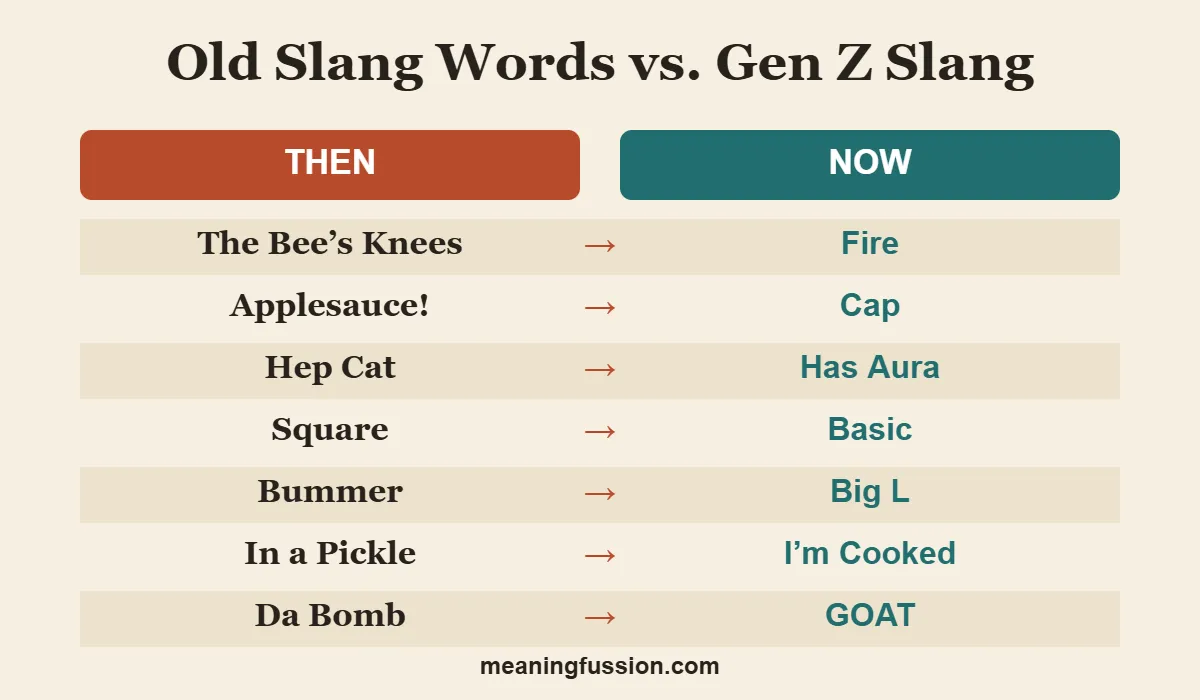
Slang changes, but the feelings behind it stay the same. Every generation needs a word for “cool,” “great,” and “I don’t believe you.” Here’s how old slang words line up with today’s Gen Z slang:
| Feeling | Old Slang Word | Gen Z Slang |
|---|---|---|
| Something is great | The bee’s knees (1920s) | Bussin’ / fire |
| Someone is charming | Smooth operator (1980s) | Rizz |
| Someone is cool | Hep cat (1940s) | Has aura |
| That’s a lie | Applesauce (1920s) | Cap |
| I’m in trouble | In a pickle (1800s) | I’m cooked |
| Someone is too in love | Lovesick (old) | Whipped / simp |
| Boring person | Square (1950s) | Basic / NPC |
| Disappointment | Bummer (1960s) | Big L |
For a full list of today’s words, read our Gen Z slang dictionary.
Old Slang Words That Came Back (Or Never Left)
Not all old slang dies. Some words disappear for years and then come back with a new meaning:
- Cool – Jazz musicians in the 1930s and 40s used it to mean calm and stylish. Almost 100 years later, it’s still the most popular slang word in English.
- Lit – Back in the early 1900s, “lit” meant drunk. Today it means exciting or amazing.
- Salty – Old sailors used it to describe someone tough and experienced. Now it means bitter or upset.
- Swag – In the 1500s, it meant to sway. Later it meant stolen goods. In the 2010s, it came back to mean style and confidence.
- Dope – Once used for drugs, it changed in 1980s hip-hop to mean “excellent.”
- Groovy – Many young people now use it again in a fun, retro way.
Some slang from old TV shows is still alive today, too. For example, people still call the police “12,” a nickname that most likely comes from the 1968 cop show Adam-12. Read the full story here: why is 12 slang for police.
Why Do Slang Words Go Out of Style?
Here are the four main reasons old slang words fade away:
- Adults start using them. When parents and brands use a word, young people usually drop it.
- Culture changes. Words like bank’s closed made sense in the flapper age but not today.
- New technology. Records, CB radios, and pagers created slang that disappeared with the tech.
- Overuse. Words like on fleek spread so fast online that people got tired of them in months.
Today, social media makes slang move faster than ever. A word can be popular on TikTok in January and feel “old” by summer.
Funny Old Slang Insults (Clean and Harmless)
Old-fashioned insults are funny because they sound so polite. Here are some clean ones you can use without hurting anyone:
- Fuddy-duddy – An old-fashioned, fussy person.
Example: “Don’t be a fuddy-duddy—try the new ride!” - Nincompoop – A silly or foolish person.
Example: “Only a nincompoop would forget their own birthday.” - Wet blanket – Someone who ruins the fun.
Example: “Stop being a wet blanket and join the game.” - Lollygagger – Someone who wastes time.
Example: “Hurry up, you lollygagger!” - Dingbat – A silly, scatterbrained person.
Example: “I locked my keys in the car again—what a dingbat!” - Goober – A goofy, silly person.
Example: “My little brother is such a goober.”
Interested in regional words too? Read our guide to hillbilly slang.
How to Use Old Slang Words Today
- Use them for fun: Old slang works best as a joke or to sound playful.
- Know your audience: Your grandparents may love “swell,” but your classmates may not get it.
- Check the meaning first: Some old slang words changed meaning or became rude over time.
- Use them in writing: Old slang is great for stories, costume parties, and retro-themed posts.
- Mix old and new: Saying “That’s the bee’s knees, no cap” is a fun way to blend generations.
FAQs About Old Slang Words
What are some old slang words?
Popular old slang words include the bee’s knees, the cat’s pajamas, swell, hep cat, daddy-o, groovy, far out, dy-no-mite, rad, tubular, as if, and da bomb. Each one comes from a different decade between the 1920s and the 1990s.
What is the oldest slang word still used today?
“Cool” is one of the oldest slang words still in everyday use. It became slang among jazz musicians in the 1930s and 1940s and has stayed popular for almost 100 years.
What are some 70s slang words?
Common 1970s slang words include dy-no-mite, right on, can you dig it, catch you on the flip side, keep on truckin’, foxy, funky, and boogie.
What are 90s slang words?
Popular 90s slang words include as if, talk to the hand, all that and a bag of chips, da bomb, phat, booyah, my bad, psych, and not.
What is 50s slang for cool?
In the 1950s, people said daddy-o, ginchiest, cool, and made in the shade to describe something or someone cool.
What does “the bee’s knees” mean?
“The bee’s knees” is 1920s slang that means something is excellent or the very best.
Why do slang words become old?
Slang becomes old when adults and brands start using it, when culture or technology changes, or when a word is overused on social media.
Final Thoughts
Old slang words are like a time machine. They show us what people loved, laughed at, and listened to in every decade, from Victorian streets to 90s malls. Some words faded, some came back, and some (like cool) never left.
Which old slang word is your favorite? Try bringing one back this week—just don’t be a square about it! For more fun guides, explore our types of slang hub.

Rose Lily
I’m Rose Lily, a writer at MeaningFussion, where I explain Gen Z slang, texting abbreviations, social media terms, internet language, and trending expressions in simple words. I create easy-to-understand guides with meanings, examples, and real-life usage to help readers understand what people mean in texts, chats, TikTok, Instagram, Snapchat, and other online conversations.