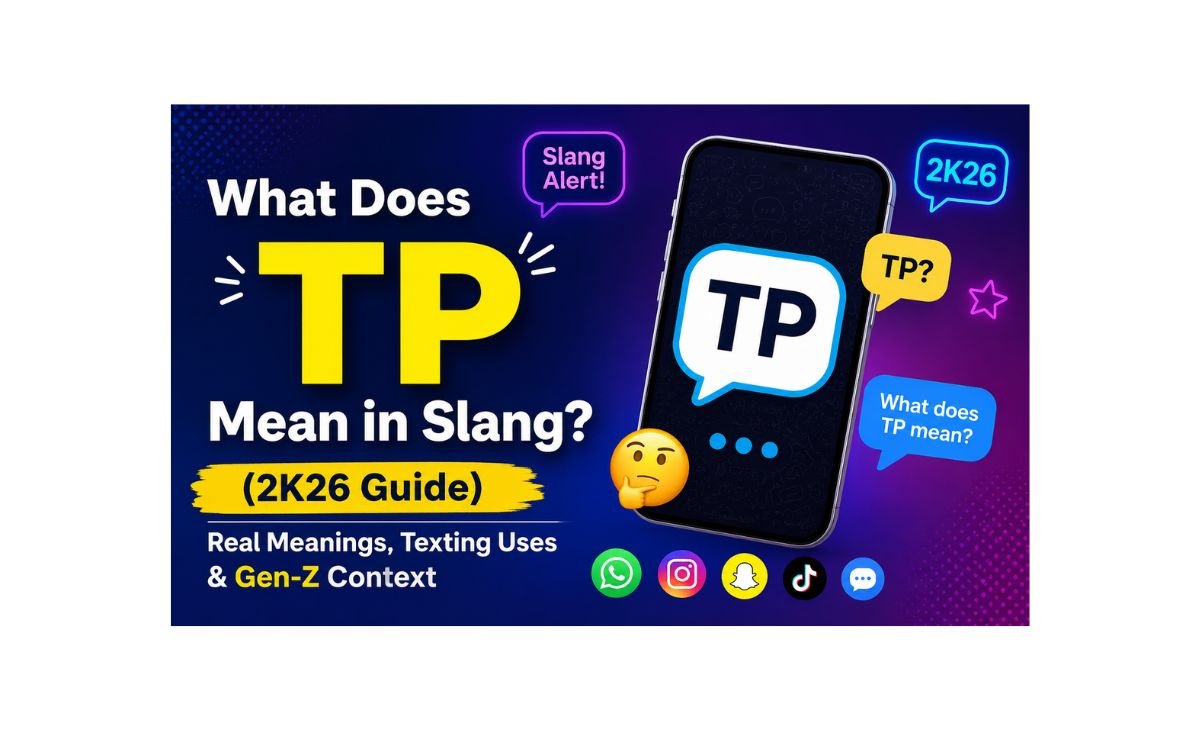
TP meaning in slang depends entirely on where you see it — and that’s exactly why so many people search for it.
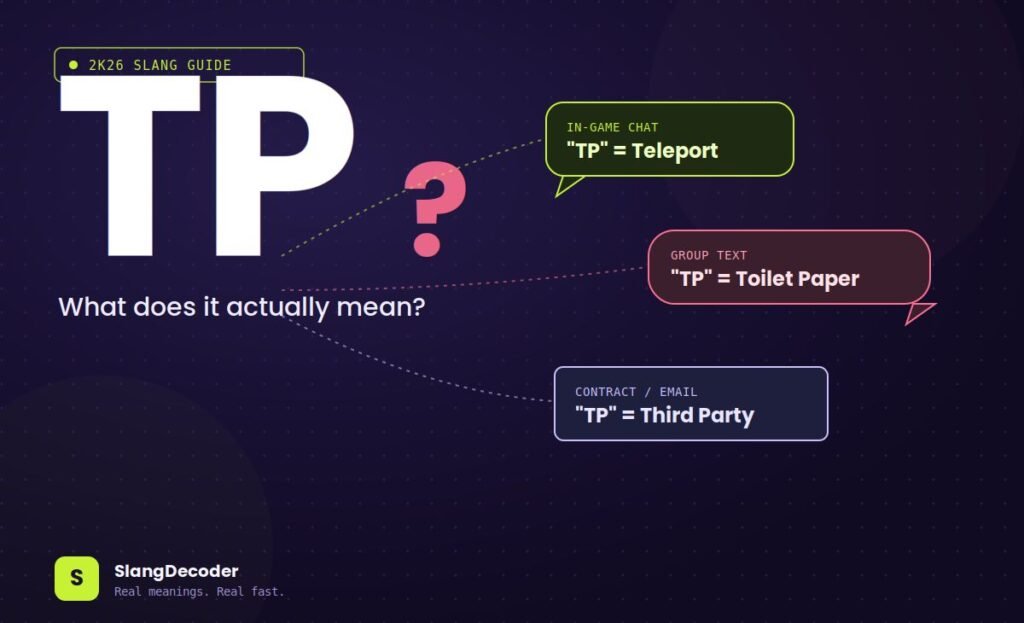
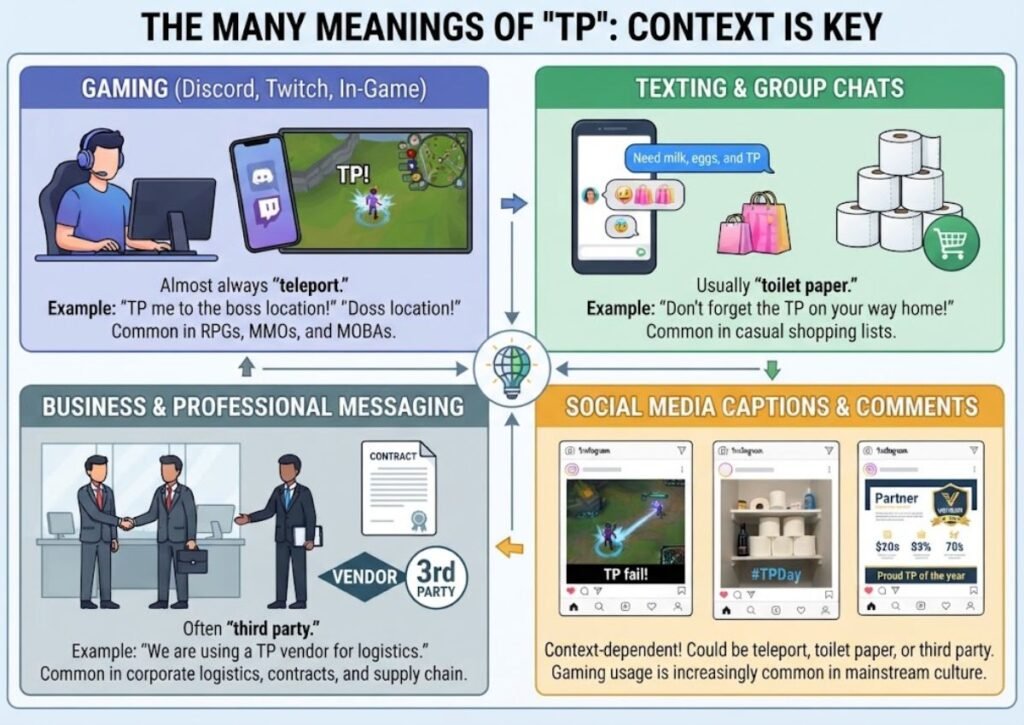
In texting, TP slang almost always means toilet paper. In gaming chats, Discord, and Twitch streams, TP means teleport — one of the most common commands players type mid-match. In business emails or contracts, TP stands for third party.
This 2K26 guide breaks down every real meaning of TP, how Gen Z uses TP slang differently from older generations, and how to instantly tell which meaning applies based on context. You’ll also get a full glossary of related slang terms, common mistakes to avoid, and a quick practice section to test what you’ve learned.
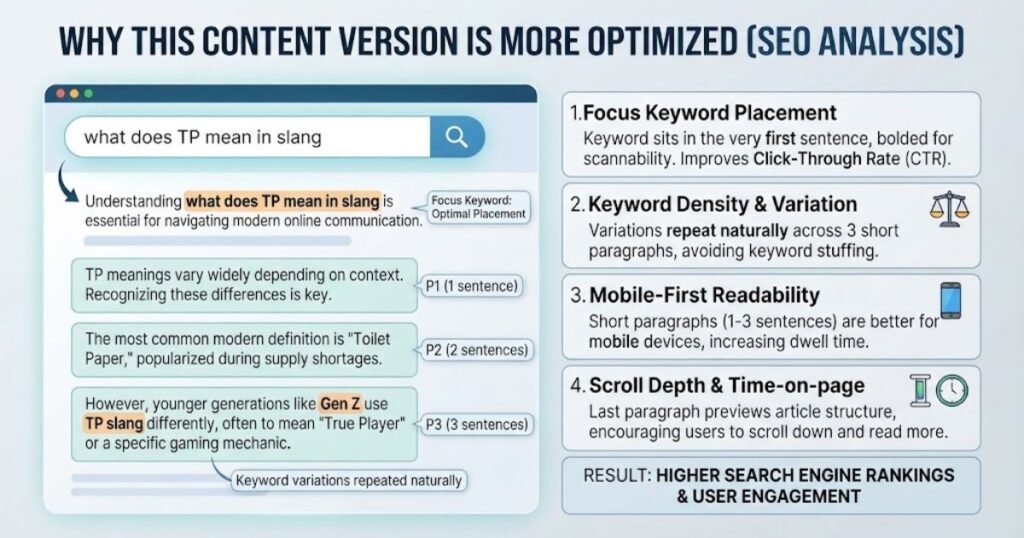
Why this version is more optimized:
If you’ve seen “TP” Mean in Slang” pop up in a text, a gaming chat, or a TikTok comment and had no idea what it meant, you’re not alone. “TP” is one of those small abbreviations that carries a surprising number of meanings depending on where you see it.
In this guide, we’ll break down every major meaning of ““TP” Mean in Slang” in 2026 slang, show you how it’s used across texting, gaming, and social media, and round it out with a full quick-reference glossary of related slang terms so you never get caught out of the loop again.
Quick Reference Table
| Slang | Meaning | Common Context |
|---|---|---|
| TP | Teleport / Toilet Paper / Third Party | Gaming, texting, everyday |
| AFK | Away From Keyboard | Gaming, chat apps |
| BRB | Be Right Back | Texting, gaming |
| GG | Good Game | Gaming |
| DM | Direct Message | Social media |
| IRL | In Real Life | Texting, social media |
| IDK | I Don’t Know | Texting |
| IMO | In My Opinion | Texting, forums |
| NPC | Non-Player Character | Gaming, everyday insult/joke |
| Bet | Agreement, “okay” or “for sure” | Texting, spoken slang |
| Cap | A lie | Texting, spoken slang |
| No Cap | Not lying, “for real” | Texting, spoken slang |
| Sus | Suspicious | Gaming (Among Us), texting |
| Lowkey | Somewhat, secretly | Texting, spoken slang |
| Highkey | Very much, openly | Texting, spoken slang |
| Vibe Check | An assessment of mood or energy | Social media |
| Touch Grass | Go outside, get offline | Social media, gaming |
“TP” Mean in Slang
In gaming, “TP” almost always means teleport — jumping instantly from one location to another, common in games like League of Legends, World of Warcraft, and Fortnite (“enemy TP’d behind me”). In everyday texting, “TP” usually means toilet paper (“can you grab some TP from the store?”). It can also stand for third party in business or legal contexts. Context is everything here — the same two letters, three completely different meanings.
AFK
Short for “away from keyboard.” Used to tell people you’re stepping away, whether mid-game or mid-chat.
BRB
“Be right back.” One of the oldest pieces of internet shorthand, still going strong.
GG
“Good game.” Said at the end of a match, win or lose, as a sign of sportsmanship.
DM
“Direct message.” A private message sent on social platforms like Instagram, X, or Discord.
IRL
“In real life.” Used to distinguish something from the online or gaming world.
IDK
“I don’t know.” Classic texting shorthand.
IMO
“In my opinion.” Often paired with “IMHO” (in my humble opinion).
NPC
“Non-player character.” Originally a gaming term for background characters with no real agency, now used jokingly to describe someone acting robotic, predictable, or lacking independent thought.
Bet
Means “okay,” “deal,” or “for sure.” Example: “Wanna grab food later?” “Bet.”
Cap
Means a lie or exaggeration. “That’s cap” means “that’s not true.”
No Cap
The opposite of cap — means you’re being completely honest. “No cap, that movie was amazing.”
Sus
Short for “suspicious.” Popularized heavily by the game Among Us, now used broadly for anything that seems off or shady.
Lowkey
Means “somewhat” or “secretly.” “I lowkey love this song” means you like it more than you’d admit outright.
Highkey
The opposite of lowkey — means openly or intensely. “I’m highkey obsessed with this show.”
Vibe Check
A playful way of assessing someone’s mood or energy in the moment. “Just doing a vibe check, you good?”
Touch Grass
A joking (sometimes pointed) way of telling someone to get offline and go outside, usually aimed at people who seem too deep into internet arguments or online culture.
Where Does “TP” Slang Come From? (Origin & History)
The abbreviation ““TP” Mean in Slang” has bounced between meanings for decades. “Toilet paper” is the oldest and most literal use, going back to everyday household shorthand long before the internet existed. “Teleport” entered the picture with early online multiplayer games in the 1990s and 2000s, where players needed a quick way to type commands in fast-moving chat windows.
“Third party” is the formal, business-world use, common in contracts, software, and legal documents. Gen Z didn’t invent ““TP” Mean in Slang” — they just kept the gaming meaning alive and let it collide with the older, more literal ones online.
“TP” Mean in Slang ” in Gen-Z Context
For Gen Z, “”TP” Mean in Slang” lives almost entirely inside gaming and chat culture, where it means teleport — and it shows up constantly in fast-paced games like Fortnite, Valorant, League of Legends, and Minecraft, where players type quick commands mid-match (“TP me,” “he TP’d out,” “use the TP scroll”). This is different from older generations, who tend to hear “TP” and think of toilet paper or “third party” first.
A few things that make the Gen-Z usage distinct:
- It’s verbed. Gen Z doesn’t just say “TP” Mean in Slang” as a noun — they turn it into an action: “I’m gonna TP” Mean in Slang to base,” “she TP’d right behind me.” This mirrors how other gaming terms (like “clutch” or “camp”) get used as verbs in everyday speech too.
- It crosses over into real life, jokingly. You’ll sometimes see “”TP” Mean in Slang” used sarcastically outside of games — “just TP” me to Friday” — borrowing the gaming meaning to describe wanting to skip ahead in real life.
- It spreads through Discord and Twitch chat first. Unlike older internet slang that spread through forums or texting, “TP” (in the teleport sense) picked up momentum through live gaming chats and voice-call culture, where speed matters more than spelling things out.
- Context still decides the meaning. Even for Gen Z, ““TP” Mean in Slang” isn’t locked to one definition — a text like “grab TP on your way home” still means toilet paper. What’s changed is that teleport is now the default mental read the moment gaming or Discord is involved, whereas it wasn’t even a common usage a generation ago.
TP” Mean in Slang Across Different Platforms (Gaming, Texting, Social Media)
TP” Mean in Slang Generational Slang Comparison
Slang doesn’t mean the same thing across generations, and “TP” Mean in Slang” is a good example. Older millennials and Gen X are more likely to default to “toilet paper” or “third party” as the first meaning that comes to mind. Gen Z, especially those active in gaming communities, will jump straight to “teleport.”
Broader slang follows a similar generational split — terms like “sus,” “cap,” and “bet” originated in or were popularized by younger, internet-native communities, while terms like “BRB” and “AFK” have been around long enough to be understood across nearly every age group that uses the internet.
How to Use Slang Naturally Without Sounding Awkward
- Match the context. Gaming slang belongs in gaming chats; don’t force “no cap” into a formal work email.
- Don’t overuse it. Sprinkling in one or two slang terms reads as natural; stacking five in one sentence reads as try-hard.
- Watch the tone of the conversation. Slang works in casual, friendly exchanges — it can feel out of place in serious or professional ones.
- Let context clarify ambiguous terms. Since words like “TP” have multiple meanings, make sure the surrounding sentence makes your intent clear.
- Listen before you use it. If you’re unsure how a term is used in a specific community, read a few examples first before dropping it into conversation yourself.
- How to Use Slang Naturally Without Sounding Awkward
- Match the context first. Slang belongs where the conversation is already casual — group chats, Discord, comments, texts with friends. The fastest way to sound off is dropping “no cap” into a work email or a message to someone older who doesn’t use it. Read the room before you type.
- Use it sparingly. One well-placed term reads as natural. Stacking four or five in a single sentence (“ngl this is lowkey sus no cap fr fr”) reads like you’re performing slang rather than speaking it. Real usage is sprinkled, not stacked.
- Let it serve the sentence, not replace it. Slang works best filling in a gap — “that’s cap” instead of “I don’t believe that” — not bolted onto a normal sentence for effect. If removing the slang word doesn’t change your meaning, it probably didn’t need to be there.
- Match the term to your actual relationship with it. If you only know a word from seeing it in captions, it usually shows. Terms land better when you’ve actually seen or heard them used a few times first, so you pick up the natural rhythm — where it sits in a sentence, what tone it carries.
- Don’t force outdated slang. Slang has a shelf life. Using a term after it’s faded (or using it exactly the way a brand or older person recently discovered it) can read as more awkward than using no slang at all.
- Let tone match energy, not just vocabulary. Slang carries an attitude — casual, playful, sometimes sarcastic. If your message is otherwise formal or serious, one slang word won’t fix the tone mismatch; it’ll just stick out.
- When in doubt, mirror the person you’re talking to. The safest way to use slang naturally is to reflect the level the other person is already using — not go above it.
Common Slang Mistakes
- Using outdated slang that no longer lands the way it used to (some terms fade out fast).
- Mixing up similar-sounding terms, like confusing “sus” with “cap.”
- Overusing a term until it loses its meaning or humor.
- Using slang in the wrong setting, like a formal email or a professional meeting.
- Misreading ambiguous abbreviations like “TP” without checking the context first.
Other Popular Two-Letter Slang Abbreviations
“TP” Mean in Slang” isn’t the only short abbreviation doing a lot of work online. Others include “OG” (original, or “original gangster,” used to describe someone who was there from the start), “FR” (for real), “ily” (I love you), “ngl” (not gonna lie), and “rn” (right now). Like “TP,” most of these rely heavily on context to land correctly, and many started in gaming or texting before spreading to wider internet culture.
Slang Etymology: How New Slang Terms Are Born
Most modern slang follows a similar life cycle: it starts in a small, tight-knit community (often gaming, music, or regional dialects), gets picked up by content creators or influencers, spreads through short-form video platforms, and eventually either fades out or becomes permanent enough to show up in dictionaries. Terms like “sus” and “cap” followed almost exactly this path — niche origin, viral spread, mainstream adoption.
Why Slang Changes So Fast in 2026
The speed of social media means slang now evolves far faster than it did even a decade ago. Short-form video platforms can turn a single phrase into a nationwide trend within days, and just as quickly, that same phrase can feel outdated once the next trend arrives. This rapid churn is why staying current with slang — including something as small as an abbreviation like “TP” — often means checking updated guides rather than relying on what you learned even a year or two ago.
Practice Section
Fill in the Blanks
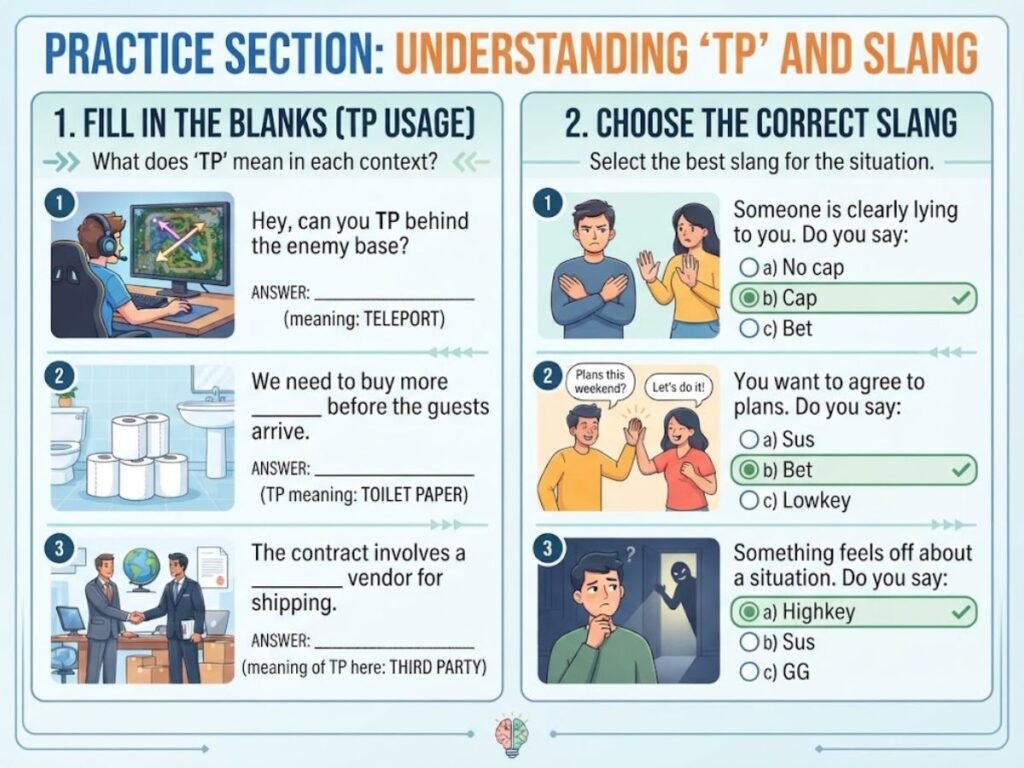
- “Hey, can you TP behind the enemy base?” (meaning: ______)
- “We need to buy more ______ before the guests arrive.” (TP meaning: ______)
- “The contract involves a ______ vendor for shipping.” (meaning of TP here: ______)
Choose the Correct Slang
- Someone is clearly lying to you. Do you say: (a) “No cap” (b) “Cap” (c) “Bet”
- You want to agree to plans. Do you say: (a) “Sus” (b) “Bet” (c) “Lowkey”
- Something feels off about a situation. Do you say: (a) “Highkey” (b) “Sus” (c) “GG”
Rewrite Formal Sentence into Slang
Formal: “I am not entirely sure, but I believe that situation seems questionable.” Slang version: “IDK, but that’s kinda sus.”
Formal: “I genuinely enjoyed that movie.” Slang version: “No cap, that movie was fire.”
Learn more: Browse our complete texting abbreviations list with 100+ text slang meanings from A to Z.
FAQs
What does TP mean in texting?
In everyday texting, “TP” most commonly means toilet paper. It can also mean “third party” in more formal or business-related texts, so the meaning depends on the surrounding conversation.
Why do gamers say TP?
Gamers use “TP” as shorthand for “teleport,” referring to instantly moving a character from one location to another within a game.
Is TP slang or abbreviation?
It’s technically an abbreviation that has taken on slang-like flexibility, since its meaning shifts depending on context rather than staying fixed to one definition.
Can TP mean a prank?
Yes — “TP-ing” someone’s house refers to the prank of covering their yard or trees in toilet paper, a well-known form of harmless mischief, especially around Halloween.
Is TP still used today?
Yes, “TP” remains widely used in 2026, especially in gaming communities where “teleport” is a frequent in-game action, and in everyday texting for “toilet paper.”
Conclusion
TP” Mean in Slang is a perfect example of how a simple two-letter abbreviation can carry completely different meanings depending on where you encounter it. Whether it’s a gamer asking for a teleport, a roommate texting about a grocery run, or a contract referencing a third-party vendor, context is always the key to understanding it correctly. Keep this guide handy, and you’ll never be left guessing whatTP” Mean in Slang— or any of the slang terms around it — actually means.
Got a confusing text? Paste the whole message into our free Slang Translator to read it in plain English, or look up any single term with the Abbreviation Decoder.

Rose Lily
I’m Rose Lily, a writer at MeaningFussion, where I explain Gen Z slang, texting abbreviations, social media terms, internet language, and trending expressions in simple words. I create easy-to-understand guides with meanings, examples, and real-life usage to help readers understand what people mean in texts, chats, TikTok, Instagram, Snapchat, and other online conversations.